When Resistance Reveals the Heart
God makes Himself known through surrendered obedience, unexpected resistance, and the quiet exposure of what the heart has chosen to trust.
Introduction: The Story Is About God
By the time we reach Exodus 7, Moses has already stood before Pharaoh once.
He and Aaron delivered the word God had given them: “Let my people go.” Pharaoh did not listen. Instead, he increased the burden on the Israelites. Their work became harder, their suffering deepened, and Moses returned to God carrying disappointment and questions.
Obedience had not produced immediate relief.
That tension matters because many of us assume that when God leads, the path will quickly become clearer. We expect obedience to reduce resistance. We imagine that a faithful step will be met with visible confirmation.
Exodus 7 gives us a different picture.
God sends Moses and Aaron back to the same resistant ruler. He tells them in advance that Pharaoh will not listen. He prepares them for confrontation, imitation, delay, and pressure.
Yet the chapter is not centered on Pharaoh’s power or Moses’ ability.
Exodus is the story of God revealing who He is.
“The Egyptians shall know that I am the Lord, when I stretch out my hand against Egypt and bring out the people of Israel from among them.”
Exodus 7:5
God is making Himself known to Moses, to Israel, to Pharaoh, to Pharaoh’s servants, and to the people of Egypt.
Some will witness His power and soften. Others will witness the same thing and resist.
The difference will not be the clarity of God’s revelation. The difference will be the posture of the heart.
Key Lessons from Exodus 7
- God’s work is meant to reveal His character, not elevate our importance.
- Our weakness does not disqualify us from obedience or limit God’s ability to work.
- Faithful obedience requires listening carefully and refusing to run ahead of God.
- Unexpected resistance does not mean God has lost control of the assignment.
- Imitation may reproduce an appearance, but it cannot overturn the work of God.
- Repeated resistance can slowly form a hardened heart.
- God invites us to respond while our hearts are still tender enough to listen.
1. God Reveals Himself Through Ordinary People
“And the Lord said to Moses, ‘See, I have made you like God to Pharaoh, and your brother Aaron shall be your prophet.’”
Exodus 7:1
This language can sound strange at first. God is not telling Moses that he has become divine. He is appointing Moses to stand before Pharaoh as His representative. Aaron will speak the words entrusted to Moses, and together they will make God’s message visible and audible in Egypt.
Pharaoh lived in a world filled with tangible representations of power. Egypt’s gods were connected to animals, rulers, land, water, fertility, and the natural world. Pharaoh himself was treated as divine.
Into that world, God sends two aging brothers carrying a wooden staff.
Moses is eighty. Aaron is eighty-three.
Neither one looks impressive beside the throne of Egypt. Yet God has chosen to reveal Himself through their obedience.
This is one of the repeated patterns of Scripture. God works through ordinary people so that the focus remains on His faithfulness rather than human impressiveness.
We can easily turn spiritual life into a search for greater confidence, greater visibility, or greater ability. But Exodus 7 draws our attention somewhere else.
The central question is not, “How impressive is the person God is using?”
The central question is, “What is God revealing about Himself?”
2. God Does Not Ignore Weakness—He Provides Within It
Moses has already named his weakness. He does not believe he speaks well. He feels inadequate for the assignment, and this insecurity follows him into the opening verses of Exodus 7.
God does not shame Moses for needing help.
He gives him Aaron.
Aaron is not there to replace Moses. He is there to complement him. Moses will receive the word from God, and Aaron will help communicate it.
This is not a picture of failure. It is a picture of provision.
Sometimes we assume that mature faith means never needing anyone. We imagine that if God has truly called us, we should be able to carry everything alone.
Scripture does not support that kind of isolation.
God often places people around us whose strengths meet our limitations. A spouse may carry tenderness where we tend toward bluntness. A friend may bring patience where we rush. A trusted guide may hear what we cannot yet name. Someone else may bring structure, mercy, courage, or discernment.
Their presence does not mean God chose the wrong person.
It may mean God never intended the assignment to be carried alone.
This theme continues in When Past Failure Makes You Afraid to Obey , a teaching from Exodus 4 about weakness, fear, support, and God’s presence.
3. Obedience Includes Restraint
“You shall speak all that I command you, and your brother Aaron shall tell Pharaoh to let the people of Israel go out of his land.”
Exodus 7:2
God gives Moses a clear boundary: speak what I command.
Not less.
Not more.
Moses is not being asked to improvise the message, soften the uncomfortable parts, or add his own pressure. He is being asked to listen and repeat what God has said.
This kind of obedience requires restraint.
Many of us know what it is like to speak too quickly. A thought appears, emotion rises, and words leave our mouths before we have fully considered them. At other times, we know something truthful needs to be said, but discomfort causes us to shorten it, soften it, or avoid it.
Exodus 7 invites us into a different rhythm.
Listen first.
Receive what God is saying through Scripture.
Let prayer slow the impulse to react.
Then speak with faithfulness and humility.
This is not about claiming divine authority for every personal impression. It is about allowing the clear witness of Scripture to shape our words, our tone, and our timing.
For a related reflection on listening and discernment, read Hearing God’s Voice .
4. God Prepares Us for Resistance
“But I will harden Pharaoh’s heart, and though I multiply my signs and wonders in the land of Egypt, Pharaoh will not listen to you.”
Exodus 7:3–4
Before Moses and Aaron return to Pharaoh, God tells them the response they will receive.
Pharaoh will not listen.
That knowledge does not sound encouraging. Most of us would rather enter a conversation believing that the other person will understand, respond, and change.
But God is preparing Moses and Aaron for what lies ahead.
He does not want Pharaoh’s resistance to become evidence in their minds that the assignment has failed.
There are moments when obedience is measured not by the response we receive but by whether we remain faithful to what God has clearly placed before us.
A conversation may not bring immediate reconciliation.
A prayer may not produce visible change that day.
A faithful boundary may be misunderstood.
A step of obedience may initially make the situation feel more difficult.
Resistance is not always proof that we have missed God.
It may simply reveal that something deeper is being confronted.
Moses and Aaron are not responsible for controlling Pharaoh’s response. They are responsible for walking with God through the next step.
Readers carrying missional or leadership responsibility may also find When Vision Feels Delayed: Leading in the Waiting helpful as a companion reflection.
5. Timing Is Part of Obedience
“When Pharaoh says to you, ‘Prove yourselves by working a miracle,’ then you shall say to Aaron, ‘Take your staff and cast it down before Pharaoh, that it may become a serpent.’”
Exodus 7:9
God gives Moses and Aaron more than an action. He gives them timing.
When Pharaoh asks for a sign, then Aaron is to cast down the staff.
The instruction is specific because obedience is not simply doing the right thing. It is doing what God has said in the way He has directed.
We sometimes receive a small measure of clarity and immediately assume we understand the entire path. We move ahead, fill in the gaps, and try to manage the outcome.
Then we become frustrated when the path does not unfold as we imagined.
God often gives enough light for the next step without handing us control of the entire process.
This keeps us close.
It keeps us listening.
It keeps us dependent on Him rather than on our ability to anticipate every detail.
Moses and Aaron do what God says. They wait for the moment Pharaoh demands proof. Then Aaron casts down the staff.
The staff becomes a serpent.
Their role is obedience. The power belongs to God.
6. Unexpected Resistance Becomes a Crisis of Trust
“Then Pharaoh summoned the wise men and the sorcerers, and they, the magicians of Egypt, also did the same by their secret arts.”
Exodus 7:11
Moses and Aaron do exactly what God commanded.
Then something unexpected happens.
Pharaoh’s magicians appear to reproduce the sign.
God had prepared Moses and Aaron for Pharaoh’s unbelief, but the passage does not record God telling them in advance that the magicians would imitate what they had done.
This is the moment when obedience becomes trust.
Will they remain still long enough to see what God does next?
Will they panic?
Will they run?
Will they assume that imitation means equality?
We experience similar moments. We take a faithful step and encounter pushback we did not expect. Someone questions our motives. An old pattern resurfaces. A counterfeit solution looks easier. A familiar fear begins speaking again.
Unexpected resistance can tempt us to abandon what was clear before the resistance arrived.
Moses and Aaron stand firm.
“But Aaron’s staff swallowed up their staffs.”
Exodus 7:12
The magicians can imitate an appearance, but they cannot overcome the authority of God.
Their serpents are swallowed.
Their power has a limit.
Their imitation cannot reverse what God has done.
7. Imitation Can Reproduce Damage but Cannot Bring Restoration
The same pattern appears when the Nile is turned to blood.
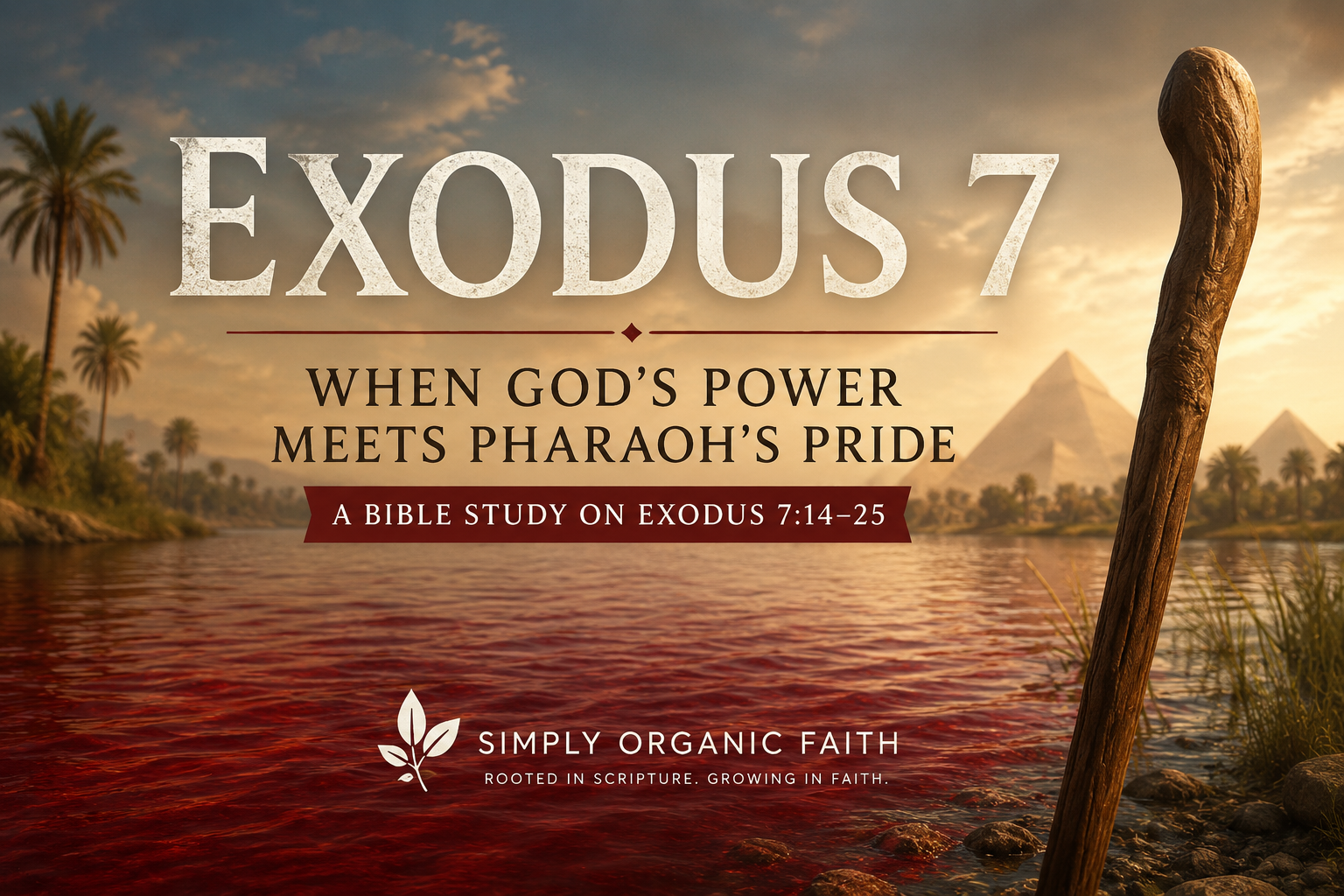
God instructs Moses to meet Pharaoh beside the river. Through Aaron’s outstretched staff, the waters of Egypt are struck. The Nile, canals, ponds, pools, and stored water become blood.
The fish die. The river stinks. The Egyptians cannot drink from it.
Once again, the magicians appear to reproduce the sign.
But there is a revealing limitation in what they do.
They can make more water unusable.
They cannot turn the blood back into water.
They can duplicate destruction.
They cannot restore what has been lost.
This is one way false power exposes itself. It may attract attention. It may imitate a sign. It may create confusion. But it cannot produce the life, freedom, healing, and restoration that belong to God.
The difference is not merely who can perform something dramatic.
The deeper question is: where does this lead?
Does it lead toward truth?
Does it lead toward freedom?
Does it lead toward humility, love, repentance, and restored life?
Or does it leave people thirstier, more confused, and more bound than before?
For another teaching about seeing beyond visible circumstances, read The Things You Don’t See: 2 Kings 6:8–17 .
8. God Meets People in Unexpected Places
“Go to Pharaoh in the morning, as he is going out to the water. Stand on the bank of the Nile to meet him.”
Exodus 7:15
God does not send Moses and Aaron back to the palace.
He sends them to the river.
The Nile was woven into Egypt’s daily survival, economy, identity, and worship. It was an ordinary destination carrying extraordinary spiritual meaning.
God chooses that place for the next confrontation.
We often expect meaningful spiritual encounters to happen in explicitly religious settings. Yet Scripture repeatedly shows God meeting people on roads, beside wells, in homes, at tables, in workplaces, on shorelines, and in wilderness places.
The ordinary rhythms of life are filled with possible intersections.
A conversation with a coworker.
A neighbor who lingers at the mailbox.
A family member who finally names what has been hurting.
A stranger whose question opens a deeper conversation.
We do not need to force spiritual meaning into every interaction. We can simply remain awake, prayerful, and available.
Moses could not control Pharaoh’s heart. But he could show up at the place God named.
Sometimes availability is the first act of obedience.
9. A Hardened Heart Refuses to Take God Seriously
“Pharaoh turned and went into his house, and he did not take even this to heart.”
Exodus 7:23
This may be one of the most sobering sentences in the chapter.
Pharaoh has seen Aaron’s staff swallow the staffs of his magicians. He has heard the word of the Lord. He has watched the Nile turn to blood. The river that sustained Egypt now carries death, and the people are digging beside it in search of drinkable water.
Pharaoh goes home.
He does not take it to heart.
A hardened heart is not merely a person asking questions. Scripture makes room for honest questions, confusion, grief, and wrestling.
Hardness is different.
Hardness sees and refuses to consider.
It hears and refuses to listen.
It encounters consequences and still protects control.
It becomes more committed to being unmoved than to knowing what is true.
Pharaoh’s heart does not become hard in a single isolated moment. His resistance is repeatedly expressed, reinforced, and confirmed.
That is why the posture of our heart matters.
Every time God brings truth into the light, we are invited to respond. We can pause, listen, confess, ask for help, and take a step toward obedience.
Or we can turn away and refuse to take it to heart.
10. Pressure Can Reveal What We Have Been Resisting
The pressure in Egypt increases because Pharaoh continues to resist.
This does not mean every hardship in our lives is a direct judgment from God. Scripture does not permit us to make that assumption about ourselves or others.
But hardship can reveal what is already present in the heart.
Pressure exposes our attachments.
It uncovers where we demand control.
It shows us what we fear losing.
It can reveal whether we are moving toward God or retreating further into ourselves.
Pharaoh interprets every sign through his commitment to remain in control. Even when his people suffer, he refuses to yield.
The invitation for us is not to become anxious and search every difficulty for hidden punishment.
The invitation is simpler and more honest:
“Lord, is there anything I have been unwilling to hear?”
“Is there a place where fear has become resistance?”
“Is there something You have already made clear?”
“What would a tender response look like today?”
We do not need to force an answer.
We can bring the questions into God’s presence and allow Scripture to search us gently and truthfully.
Continue reflecting with Trusting God Beyond Control: A Study of Proverbs 3:5–6 .
11. Human Resistance Cannot Silence God’s Witness
Pharaoh refuses to listen, but he is not the only person watching.
His servants are present when Aaron’s staff becomes a serpent.
The magicians witness their staffs being swallowed.
The people of Egypt experience the Nile becoming unusable.
For seven days, they live with the limits of Egypt’s spiritual power. Their magicians may reproduce a sign, but they cannot restore the water.
Pharaoh’s resistance does not prevent God from revealing Himself to everyone else.
This offers a quiet encouragement.
We may not see the response we hoped for from the person directly in front of us. Yet faithfulness is rarely witnessed by one person alone.
Children are watching.
Friends are watching.
Coworkers are watching.
People we may never notice are observing whether our lives point toward control or surrender, fear or trust, performance or truth.
We are not responsible for manufacturing their response.
We are invited to live in such a way that God’s character remains visible through honesty, humility, love, and obedience.
For those carrying leadership responsibility, the Simplicity Church Network offers a related teaching: Surrendered Leadership: Why Living Sacrifices Make Better Leaders .
Conclusion: Let the Word Reach Your Heart
Exodus 7 brings us face to face with two very different postures.
Moses and Aaron are weak, imperfect, and dependent. Yet they listen, go, speak, wait, and obey.
Pharaoh is powerful, established, and surrounded by people who reinforce his authority. Yet he refuses to listen. Even when the truth becomes costly, he turns away and does not take it to heart.
The difference is not natural strength.
The difference is surrender.
God is still the center of the story.
He is greater than Pharaoh.
He is greater than imitation.
He is greater than resistance.
He is greater than Moses’ weakness.
And He remains patient enough to speak clearly before the pressure increases.
What stands out to you in this passage?
Perhaps you see yourself in Moses, carrying weakness into an assignment that feels too large.
Perhaps you recognize the shock of unexpected resistance.
Perhaps Pharaoh’s response exposes an area where you have heard God’s truth but have not allowed it to reach your heart.
You do not need to produce a dramatic response.
Begin with honesty.
Let the passage sit before you.
Ask the Holy Spirit to make your heart tender.
Then take the next faithful step God has already made clear.
Frequently Asked Questions
What is the main message of Exodus 7?
Exodus 7 shows God revealing Himself as Lord through Moses and Aaron’s obedience, Pharaoh’s resistance, the defeat of counterfeit power, and the first plague. The chapter contrasts surrendered obedience with a heart that repeatedly refuses to listen.
Why did God send Moses back when Pharaoh would not listen?
Moses’ assignment was not dependent on Pharaoh’s immediate response. God was revealing His character, preparing Israel for deliverance, confronting Egypt’s false sources of power, and making Himself known to a much wider audience.
What does it mean that God hardened Pharaoh’s heart?
The Exodus account describes both Pharaoh hardening his own heart and God hardening or confirming it. The narrative presents a ruler who repeatedly resists clear revelation until that resistance becomes settled. The passage warns us not to treat continued refusal as spiritually neutral.
Why could the Egyptian magicians imitate the signs?
The text says they acted through their secret arts but does not fully explain the mechanism. The emphasis is on their limitation. They could imitate appearances, but they could not overcome Aaron’s staff, reverse the plague, restore the Nile, or free the people.
Does resistance mean I have misunderstood God?
Not always. Exodus 7 shows that resistance can occur even when someone is walking in clear obedience. Resistance should lead us back to Scripture, prayer, humility, and wise discernment rather than causing us to assume automatically that God is absent.
How can I keep my heart from becoming hardened?
Respond to truth while it is present. Bring questions honestly before God, confess resistance, remain in Scripture, receive wise support, and take small steps of obedience. A tender heart is formed through repeated willingness to listen and respond.
Reflection Questions
- What does Exodus 7 reveal about the character and authority of God?
- Where are you tempted to measure obedience by the response you receive?
- Have you encountered resistance that caused you to question something God had previously made clear?
- Who has God placed in your life to complement your weakness or help you carry what you cannot carry alone?
- Is there an area where you have been speaking too quickly or adding more than God has asked you to say?
- What form of imitation, distraction, or counterfeit power has been competing for your trust?
- Is there anything you have seen or heard but have not yet taken to heart?
- What would a tender response to God look like today?
Action Steps
- Read Exodus 7 slowly. Notice every reference to speaking, listening, obeying, knowing, and the heart.
- Name one area of resistance. Write down something God has already made clear through Scripture that you have been avoiding or delaying.
- Pause before speaking. In one important conversation this week, pray first and ask God to shape both your words and your timing.
- Receive support. Identify one trusted person whose strength complements your weakness, and invite them to pray or walk with you.
- Take one faithful step. Do not try to control the entire outcome. Simply respond to the next thing God has made clear.
Closing Prayer
Father, thank You for making Yourself known.
You are greater than the powers that frighten us, the resistance that surprises us, and the weakness that makes us feel unqualified.
Teach us to listen before we speak. Help us walk in step with Your Word instead of rushing ahead or holding back.
When resistance comes, keep us from panic, pride, or retreat. Give us patience to remain faithful while You reveal what is true.
Search our hearts. Show us where fear, control, disappointment, or repeated delay has made us less willing to listen.
Keep our hearts tender before You.
Give us courage to receive Your truth, humility to accept the help You provide, and grace to take the next faithful step.
Let our lives reflect Your character—not through performance, but through surrendered obedience.
In Jesus’ name, amen.