Luke 6:12–16 Bible Teaching
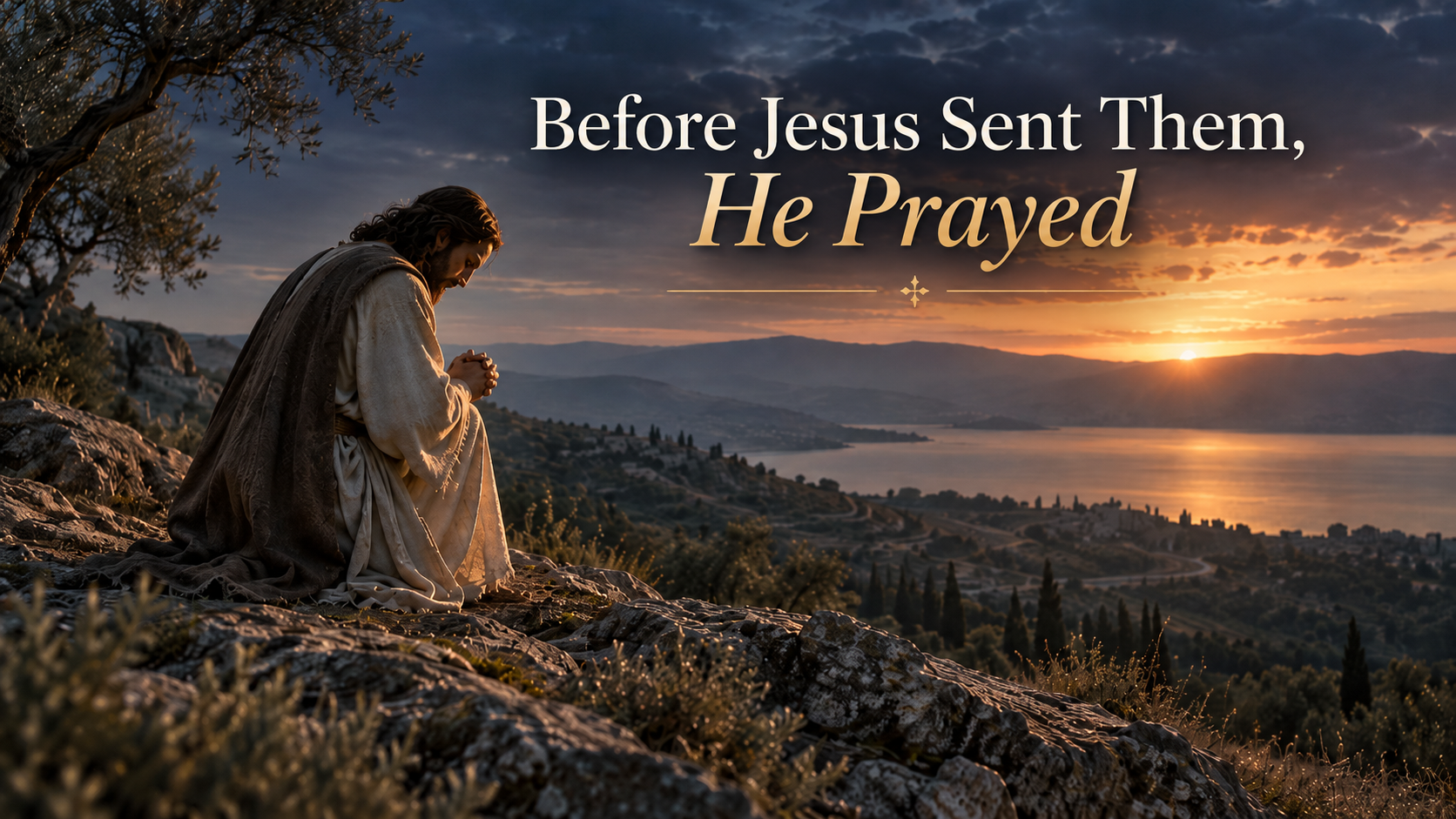
Before Jesus Sent Them, He Prayed
Jesus did not choose the twelve in a hurry. Before He called them apostles, He withdrew from the crowd, went up on a mountain, and spent the night in prayer. Luke 6:12–16 invites us to slow down long enough to notice the connection between being with the Father and being sent into the world.

Why These Men?
If you were choosing the people who would carry the message of Jesus into the world, the names in Luke 6 might not be the names you would expect.
They were not the religious elite of Jerusalem. They were not a carefully assembled collection of scholars, rabbis, or influential leaders. Among them were fishermen, a tax collector, a political zealot, men with strong personalities, men who would misunderstand Jesus, and one who would eventually betray Him.
Yet these are the people Jesus chose.
Luke wants us to notice something before he gives us their names. The story does not begin with the selection. It begins with prayer.
“In these days he went out to the mountain to pray, and all night he continued in prayer to God. And when day came, he called his disciples and chose from them twelve, whom he named apostles.”
— Luke 6:12–13
Before Jesus sent anyone, He withdrew. Before He chose, He prayed. Before there was public mission, there was hidden communion with the Father.
That order matters for us too.
Key Takeaways from Luke 6:12–16
- Jesus made room for extended prayer before a significant decision.
- Prayer is more than presenting requests; it is relationship with the Father.
- Jesus chose ordinary, imperfect, and remarkably different people.
- A disciple follows Jesus; an apostle is one who is sent on His behalf.
- Being with Jesus prepares us to be sent by Jesus.
- The gospel we carry is not something we earn—it rests on the finished work of Christ.
- Our question is not merely, “Am I following Jesus?” but also, “Where is Jesus sending me?”
1. Jesus Withdrew from the Noise
Luke places this moment in a season of growing pressure. Crowds were following Jesus. People wanted healing. Religious leaders were increasingly challenging Him. Demands surrounded Him almost everywhere He went.
Jesus responded by going to the mountain.
He deliberately stepped away from the voices around Him so He could attend to the Father.
That can be difficult for us because most of life works in the opposite direction. Notifications arrive. People need something. Work keeps moving. Responsibilities do not disappear simply because we want quiet.
Sometimes our prayers begin to resemble a drive-through window: a quick list of needs, a hurried amen, and then back into the day.
Jesus shows us another rhythm.
He made room to remain with the Father.
Formation often begins when we become quiet enough to stop managing the conversation and simply remain with God.
This does not mean every prayer time must last through the night. Luke is showing us the posture of Jesus: important movement outward was preceded by intentional movement toward the Father.
If prayer has become hurried or mostly transactional, you may find this teaching on how Jesus taught us to pray helpful as you slow down and return to the simplicity of being with God.
2. Prayer Is Not Only Talking
Luke says Jesus “continued in prayer to God.” There is something deeply relational in that description.
Healthy prayer is not simply us speaking endlessly while God listens. Prayer creates space for attention, surrender, Scripture, worship, listening, and response.
We bring our hearts honestly before God, but we also become attentive to Him.
Sometimes that requires staying long enough for the internal noise to settle.
You may discover how much noise you are carrying only after you become still. Thoughts wander. Unfinished tasks come to mind. Old conversations replay themselves. The phone suddenly seems unusually interesting.
Do not interpret distraction as failure. Simply return your attention to Jesus.
“My sheep hear my voice, and I know them, and they follow me.”
— John 10:27
Listening to God is not about chasing impressions or forcing an answer. We begin with Scripture, remain attentive to the Holy Spirit, and allow what God has already spoken to shape our thoughts, desires, and obedience.
The goal is not a dramatic experience. The goal is relationship.
3. Jesus Chose Ordinary People
After the night of prayer, Jesus called His disciples together and chose twelve.
“Simon, whom he named Peter, and Andrew his brother, and James and John, and Philip, and Bartholomew, and Matthew, and Thomas, and James the son of Alphaeus, and Simon who was called the Zealot, and Judas the son of James, and Judas Iscariot, who became a traitor.”
— Luke 6:14–16
Read the names slowly.
Peter would speak before thinking. Thomas would struggle to believe what others told him about the resurrection. Matthew had collected taxes for Rome. Simon had been identified with the Zealots, a movement fiercely opposed to Roman domination.
Imagine Matthew and Simon sitting at the same table.
Apart from Jesus, they had reasons to distrust one another.
Yet Jesus called both.
Jesus did not build His mission around people who already had everything together. He called people who would have to be formed by being with Him.
That matters if you have ever assumed your history, personality, failure, questions, or lack of religious credentials disqualifies you from meaningful obedience.
Peter’s story is especially encouraging. Failure would become part of his journey, but it would not be the end of his journey. Jesus would restore him and call him forward again.
If past failure has made obedience feel frightening, you may also want to read When Past Failure Makes You Afraid to Obey .
4. Jesus Called Disciples—and Then Sent Them
Luke makes an important distinction.
Jesus called His disciples, and from among them He chose twelve whom He named apostles.
A disciple is a learner and follower. An apostle is one who is sent.
Before these men were sent by Jesus, they first had to be with Jesus.
We should not reverse that order.
Christian mission is not sustained by activity alone. We cannot continually pour out what we are unwilling to receive. We cannot represent Jesus faithfully while slowly becoming strangers to His presence.
This is why prayer and mission belong together.
The Simplicity Church Network explores this same movement from communion into mission in Prayer That Leads: How Jesus Forms Leaders in the Secret Place . That leadership and missional application is distinct from the personal formation emphasis here, but the pattern begins in the same place: presence before assignment.
5. Following Jesus Was Never Meant to Stop with Us
It is possible to think of Christianity almost entirely in terms of what we receive.
Forgiveness. Peace. Help. Healing. Hope. Eternal life.
All of these are gifts of grace.
But Jesus was forming people who would eventually carry what they had received into the lives of others.
Later, when many people walked away because Jesus’ teaching had become difficult, He asked the twelve whether they wanted to leave too.
“Simon Peter answered him, ‘Lord, to whom shall we go? You have the words of eternal life, and we have believed, and have come to know, that you are the Holy One of God.’”
— John 6:68–69
Something had taken root in them.
They were not merely attracted to what Jesus could do for them. They had come to believe that life itself was found in Him.
That is the foundation of faithful witness.
We do not share Jesus because we have mastered an evangelism technique. We speak of Him because we have discovered that there is nowhere else to go.
And we do not have to carry that life alone. Scripture continually draws believers toward shared life, encouragement, and mutual formation. You can explore that more in Consider One Another: Why the Christian Life Was Never Meant to Be Lived Alone .
6. The Message We Carry Is Grace
What could make ordinary people willing to carry the message of Jesus into difficult places?
The answer is the gospel itself.
Scripture tells us that sin separates us from God and that the wages of sin is death. But it does not leave us there.
“For the wages of sin is death, but the free gift of God is eternal life in Christ Jesus our Lord.”
— Romans 6:23
Jesus lived the life we could not live and gave Himself for us at the cross. Forgiveness is not the reward for finally becoming good enough. Grace is God’s gift to us through Christ.
At the cross Jesus declared:
“It is finished.”
— John 19:30
There is nothing we can add to the completed work of Jesus in order to make ourselves worthy of grace.
The gospel is not “do enough so God will receive you.” The gospel is that Christ has done what we could never do for ourselves.
That message changes the way we live, and eventually it changes the way we relate to the people around us.
For those exploring the missional implications of carrying that message into everyday relationships, the Simplicity Church Network teaching Disciple First: Why Discipleship Can’t Be Reduced to Models develops that outward dimension further.
7. Who Is Jesus Sending You Toward?
Luke 6 does not invite us to admire the twelve from a distance.
Their names eventually turn the question back toward us.
Where is Jesus asking you to live faithfully today?
It may not involve crossing an ocean. It may involve crossing a room.
It may be the coworker who keeps asking spiritual questions. The neighbor who seems unusually lonely. The family member with whom conversation has become strained. The person who has been wounded by religion but is still curious about Jesus.
Being sent does not mean applying pressure.
Often it looks like presence. Listening. Serving. Praying. Telling the truth about what Jesus has done. Remaining available to the Holy Spirit.
This is not about manufacturing spiritual conversations. It is about becoming attentive enough to recognize the ones God has already placed in front of you.
For those serving in explicit missional or discipling roles, the Simplicity Church Network resource How to Keep Discipleship Spirit-Led, Not Scripted offers a practical extension of that posture.
8. We Are Sent from the Place of Prayer
There is another pattern worth noticing in the larger story of the disciples.
When Jesus was arrested, these men scattered.
After the resurrection, we eventually find them gathered again, praying together. Then Acts 2 records the coming of the Holy Spirit.
The frightened men who once fled would become courageous witnesses.
Their transformation did not come from discovering a better promotional strategy. They had encountered the risen Jesus, they waited together before God, and the Holy Spirit empowered them.
The Christian life still depends upon the Spirit.
If you are learning what it means to live attentively to His work in you, continue with Walking by the Spirit: How God Forms Self-Control in Us .
We withdraw to be with Jesus not so we can remain withdrawn, but so that His presence can shape the way we return to the people He has placed around us.
Before the Assignment Comes the Presence of God
Luke could have begun this passage with twelve names.
Instead, he began with Jesus praying.
That may be the invitation you need most today.
You do not have to figure out your entire assignment. You do not have to force clarity. You do not have to prove that you are useful to God.
Begin by being with Him.
Open Scripture. Put the phone down. Become quiet. Tell God what is actually happening inside you. Then stay long enough to listen.
The men Jesus chose were ordinary people. Their strength would not come from impressive credentials. Their lives would be formed through relationship with Jesus and empowered by the Holy Spirit.
The same Jesus still meets ordinary people.
And ordinary people who remain with Him can live remarkably faithful lives.
Frequently Asked Questions
Why did Jesus pray all night before choosing the twelve apostles?
Luke does not give us a transcript of Jesus’ prayer, but he deliberately connects the night of prayer with the choosing of the twelve. The passage shows Jesus making significant room for communion with the Father before an important moment in His mission.
What is the difference between a disciple and an apostle?
A disciple is a learner or follower. The word apostle refers to one who is sent. In Luke 6, Jesus calls His disciples and selects twelve from among them whom He names apostles. They would have a particular role as witnesses and representatives of Jesus.
Does Luke 6 mean every Christian should call himself or herself an apostle?
Luke 6 is specifically describing the twelve chosen by Jesus. The passage does, however, remind every believer that following Jesus has an outward dimension. All believers are called to bear witness to Christ and participate faithfully in His mission, even though the role of the twelve in the New Testament is unique.
How can I create more space to hear God in prayer?
Begin simply. Choose a quiet place, remove unnecessary distractions, bring your Bible and perhaps a journal, and give yourself enough time to become still. Start with Scripture rather than trying to manufacture an experience. Ask God to form your heart, then respond to what Scripture makes clear.
What if I feel too ordinary or flawed for God to use me?
The twelve should encourage you. Jesus called people with different backgrounds, weaknesses, questions, and failures. Their usefulness did not rest on appearing impressive. They were formed through relationship with Jesus. Faithfulness begins with responding to Him where you are.
What does it mean to be sent by Jesus today?
For most people, being sent begins in ordinary relationships. It may mean loving a neighbor, serving a coworker, encouraging another believer, sharing the gospel when an opportunity opens, or simply becoming more attentive to someone God has already placed in your life.
Reflection Questions
- When you read Luke 6:12–16, what stands out to you before anything else?
- Has prayer become mostly a place where you give God requests, or is there room for quiet, Scripture, listening, and response?
- What distraction most often keeps you from becoming still before God?
- Which of the people Jesus chose encourages or challenges you most?
- Where have you assumed that your past, personality, questions, or failures make you unusable?
- Who has God already placed around you that may need the presence, love, and truth of Jesus?
- What might change if you spent time with God before trying to determine your next assignment?
Why Did Jesus Choose These Ordinary Disciples?
- Read Luke 6:12–16 slowly. Read it several times this week without rushing to explain it. Notice the sequence: Jesus withdrew, prayed, called, chose, and sent.
- Create one hour of undistracted space with God. Turn off the screen. Put your phone somewhere you cannot casually reach it. Bring your Bible and a notebook. You do not need to fill the hour with words.
- Ask one simple question: “Jesus, who have You placed in front of me to love faithfully?”
- Respond to one clear invitation. Send the message. Make the phone call. Listen to the person. Offer prayer. Share what Jesus has done when the opportunity naturally opens.
Do not try to manufacture a dramatic assignment. Faithfulness often begins with the next person and the next act of obedience.
A Closing Prayer
Father, teach me to come away from the noise and be with You.
Slow my heart when I am hurried. Quiet the distractions that keep me from paying attention to You. Help me approach prayer as relationship, not simply as a place to bring my requests.
Jesus, thank You for calling ordinary people to follow You. When I feel inadequate, remind me that my confidence is not in my strength but in Your grace.
Holy Spirit, form the life of Jesus in me. Show me where You are inviting me to obey. Help me recognize the people You have already placed in front of me, and teach me to love them without pressure, serve them without needing recognition, and speak of Jesus with humility and courage.
Root me in Jesus. Lead me by Your Spirit. Teach me to live simply and faithfully.
Amen.