When Past Failure Makes You Afraid to Obey
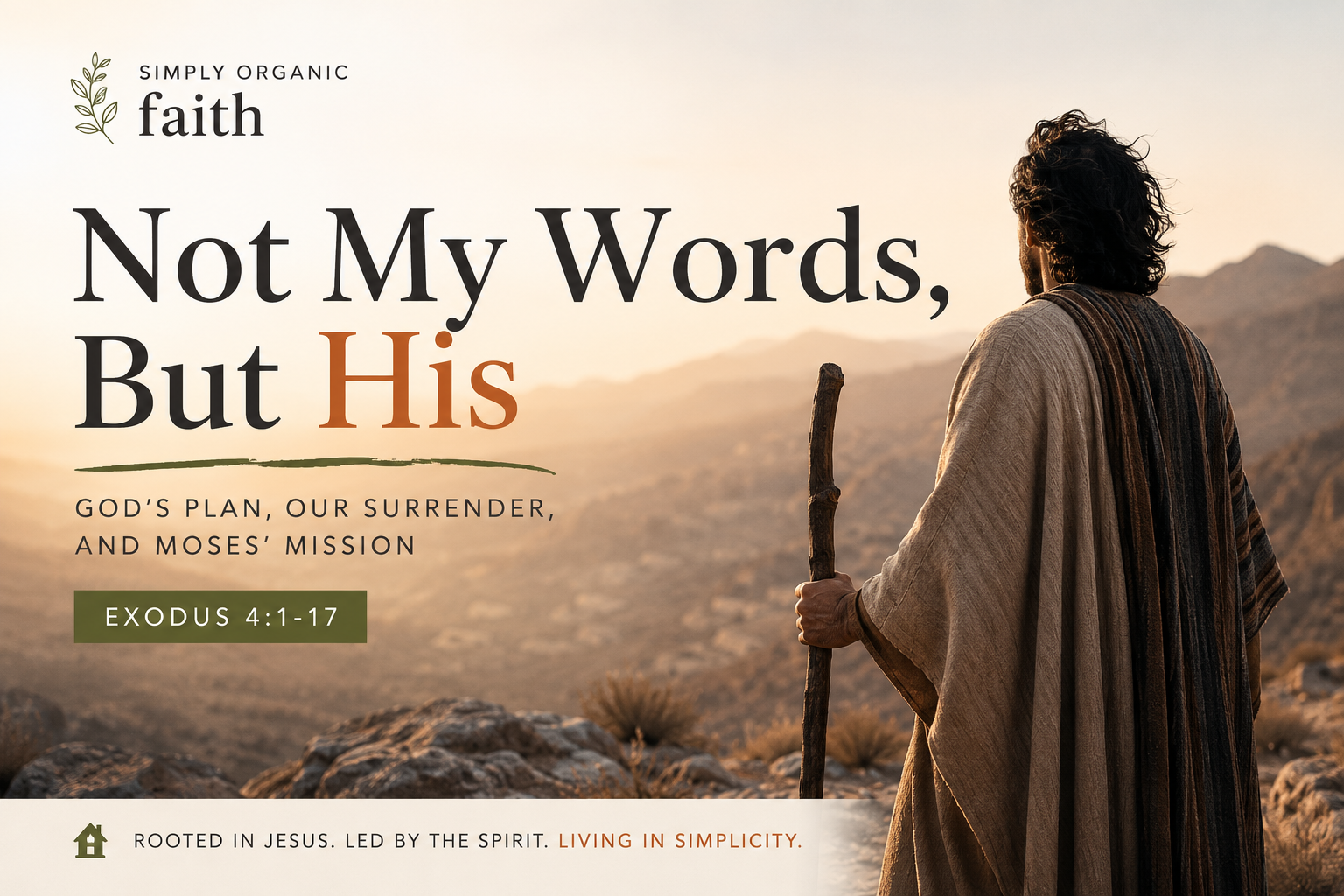
Exodus 4:1–17 shows how God meets Moses in fear, inadequacy, and remembered failure—and gently brings him back to the next faithful step.
Some passages become clearer when we slow down long enough to notice the story behind the story.
Exodus 4 is one of those passages. Moses is standing before God, listening to a call that sounds both holy and impossible. He has been told to return to Egypt, gather the elders of Israel, speak to Pharaoh, and lead an oppressed people toward freedom.
But Moses is not hearing those words as a blank slate. He is hearing them through the memory of what happened forty years earlier.
Acts 7 tells us that Moses once believed his fellow Israelites would understand that God was giving them help through him. They did not understand. His attempt to intervene ended in violence, rejection, and exile. The man who had been raised in Pharaoh’s household became a shepherd in Midian.
So when Moses says, “They will not believe me,” he is not inventing a theoretical concern. He is naming an old wound.
“But behold, they will not believe me or listen to my voice, for they will say, ‘The Lord did not appear to you.’”
Exodus 4:1
Perhaps you know what it is like to hear a new invitation from God through the memory of an old failure. You may still love Jesus. You may still want to obey. Yet something in you pulls back because the last attempt was painful.
Exodus 4 does not rush past that tension. God listens to Moses. He answers him. He reveals His power. He promises His presence. And then He asks Moses to move.
Key Takeaways
- Past failure can shape the way we hear a present invitation from God.
- God is not limited by what feels ordinary, small, or unimpressive in our hands.
- God’s call rests on His presence and power, not our flawless confidence.
- Questions are not the same as refusal; God patiently answers Moses until his hesitation becomes a direct “no.”
- God may provide people to walk with us, but their support does not erase our own step of obedience.
1. The Failure Behind the Fear
Moses’ first objection is about credibility: “They will not believe me.”
That fear makes sense when we remember his history. At forty years old, Moses had education, access, cultural fluency, and influence. Acts 7 says he was “mighty in his words and deeds.” Yet when he moved in his own strength, his intervention collapsed. His people rejected him, Pharaoh wanted him dead, and Moses fled.
Forty years later, God sends him back toward the very people connected to his deepest public failure.
Failure changes as we grow older. A child can fall from a bicycle, get back up, and try again. Adult failure often carries names, faces, consequences, and shame. It can make us cautious in places where we were once bold. It can cause us to confuse wisdom with avoidance.
Moses is not only afraid of Pharaoh. He is afraid of being dismissed again by his own people.
God does not pretend Moses’ past never happened. He meets Moses inside the memory and gives him a different foundation for moving forward. The first attempt had been driven by Moses’ timing, Moses’ strength, and Moses’ assumptions. This time, God would send him, speak through him, and remain with him.
That distinction matters. The call was not a demand for Moses to recreate his former confidence. It was an invitation to trust God in a way he had not trusted Him before.
2. When the People Closest to Us Might Not Believe Us
Rejection from strangers can hurt. Rejection from people who know us can reach much deeper.
Moses can imagine the elders looking at him and asking, “Why you?” He has been gone for decades. He has no army. He has no public platform. He carries a shepherd’s staff, not a royal seal.
God’s response is striking. He does not tell Moses that everyone will immediately understand. In fact, He prepares Moses for the possibility that one sign may not be enough. God is honest about the resistance Moses may face.
This is a gentle correction to the idea that obedience always produces quick affirmation. Sometimes people need time. Sometimes they do not recognize what God is doing at first. Sometimes faithful obedience is misunderstood.
The presence of questions around us does not automatically mean the absence of God within the invitation.
This does not mean we should become unteachable or use “God told me” to silence wise counsel. It means our peace cannot depend entirely on being immediately understood by everyone we love.
For a slower reflection on discernment, read
Hearing God in the Quiet: How to Listen and Know His Voice.
3. “What Is That in Your Hand?”
“The Lord said to him, ‘What is that in your hand?’ He said, ‘A staff.’”
Exodus 4:2
Moses is looking at the size of the assignment. God draws his attention to something ordinary.
A shepherd’s staff was familiar, practical, and unimpressive. It was connected to Moses’ present life in the wilderness. Yet God chose that ordinary object as a sign of His power.
Moses throws it down, and it becomes a serpent. He runs from it. Then God tells him to take it by the tail—an instruction that would have felt dangerous and unreasonable. When Moses obeys, the serpent becomes a staff again.
The point is not that ordinary objects become magical. The point is that what is ordinary in human hands can become significant when surrendered to God’s purpose.
Your “staff” may be a trade, a kitchen table, a phone, a vehicle, a computer, a listening ear, a home, a story, or a skill you have stopped noticing because it feels so familiar.
We often search for what we do not have. God may begin by asking what is already present.
The question is not merely, “What can I do with this?” A more formational question is, “What might become possible if this is no longer held only for me?”
4. The Staff, the Hand, and the Water
God gives Moses three signs: the staff becomes a serpent, his hand becomes diseased and is restored, and water from the Nile becomes blood on the ground.
Each sign points beyond Moses. The signs reveal that the God who is sending him is greater than the powers Moses fears.
God is greater than what frightens you
The serpent produces an immediate reaction in Moses—he runs. Yet the thing he fears remains under God’s authority. God does not tell Moses to pretend the serpent is harmless. He shows Moses that danger itself is not outside His rule.
God is Lord over weakness and restoration
Moses places his hand inside his cloak. When he removes it, the hand is visibly diseased. He puts it back, and it is restored.
Moses will soon say that his own body and speech make him unfit for the assignment. Before that objection is spoken, God is already revealing that human limitation does not place Him at a disadvantage.
God is greater than the systems that appear untouchable
The Nile was woven into Egypt’s economy, survival, and identity. By turning its water to blood, God signals that even Egypt’s apparent source of life is not ultimate.
Moses is being sent into a world where Pharaoh looks absolute. The signs teach him to see more clearly: Pharaoh is powerful, but he is not sovereign.
We sometimes need that same reorientation. The obstacle may be real. The system may be entrenched. The history may be painful. Yet none of those things are God.
A related teaching is
The Things You Don’t See: 2 Kings 6:8–17,
which explores how Scripture helps us see beyond visible pressure.
5. “I Am Slow of Speech and of Tongue”
“Oh, my Lord, I am not eloquent… but I am slow of speech and of tongue.”
Exodus 4:10
After raising concerns about the people, Moses turns the conversation toward himself.
“I cannot speak well.”
The objection sounds especially interesting beside Acts 7, where Moses is described as mighty in words and deeds. Perhaps forty years in the wilderness changed how Moses saw himself. Perhaps the failure in Egypt damaged his confidence. Perhaps he is naming a genuine limitation. The text does not require us to solve that question before hearing God’s response.
God does not argue that Moses is secretly eloquent. He redirects Moses toward the Creator:
“Who has made man’s mouth? … Is it not I, the Lord? Now therefore go, and I will be with your mouth and teach you what you shall speak.”
Exodus 4:11–12
God’s answer is not, “You are more capable than you think.” His answer is, “I made you. I know you. I will be with you. I will teach you.”
That is a deeper foundation than self-confidence.
There are moments when encouragement rightly helps us recognize gifts we have overlooked. But Scripture does not place the weight of obedience on our ability to create a strong enough view of ourselves. Moses’ security rests in the character and presence of God.
The question shifts from “Am I enough?” to “Will the God who sends me be present?”
In Exodus 4, His answer is yes.
For further reflection, see
Trusting God Beyond Control: A Study of Proverbs 3:5–6.
6. God Is Not Threatened by Honest Questions
Moses asks questions. He names fears. He raises objections. Through much of the conversation, God responds patiently and specifically.
This matters for anyone who has been taught that faith means hiding uncertainty. The passage does not portray God as fragile. He is not unsettled by Moses’ fear. He does not abandon the conversation when Moses struggles.
But verse 13 marks a change:
“Oh, my Lord, please send someone else.”
Exodus 4:13
Moses is no longer asking how. He is asking not to go.
The anger of the Lord is kindled because the conversation has moved from uncertainty toward refusal. God has answered each objection. He has revealed His power. He has promised His presence. Yet Moses still wants the assignment transferred.
There is a difference between bringing our fear into God’s presence and using fear to permanently close the door on obedience.
You do not need to force an answer right away. It may be worth reflecting on where you are in that movement. Are you still listening honestly? Are you asking for clarity? Or has hesitation quietly hardened into a settled “no”?
7. Aaron Is Help, Not a Replacement
God tells Moses that Aaron is already coming to meet him. Aaron can speak well. God will be with both of them and teach them what to do.
This is grace. Moses will not walk alone.
Yet Aaron’s presence does not cancel Moses’ call. Aaron will assist, but Moses must still return. Moses must still carry the staff. Moses must still stand before the elders. Moses must still obey.
God often provides people who strengthen us where we feel weak. A wise friend, a patient spouse, a mentor, a prayer partner, or a faithful community can become part of His provision.
Support is not evidence that the call was never ours. Sometimes support is precisely how God helps us carry it.
For readers serving in missional or leadership settings, the Simplicity Church Network offers a related reflection on
surrendered leadership.
Another helpful resource is
When Vision Feels Delayed: Leading in the Waiting.
8. Take the Staff With You
“And take in your hand this staff, with which you shall do the signs.”
Exodus 4:17
The chapter does not end with Moses feeling completely fearless. It ends with a concrete instruction.
Take the staff.
The staff is still ordinary wood. It is also now a reminder. Moses has seen what God can do with what is surrendered. Every step toward Egypt will be taken with that reminder in his hand.
The next step in obedience is often simpler than the whole assignment. Make the call. Offer the apology. Open the Bible. Tell the truth. Rest. Ask for help. Begin the conversation. Return to the place you have avoided.
We do not have to carry the entire future at once. We can carry the next faithful thing.
Continue with
Here I Am, Send Me: From Encounter to Obedience.
Conclusion: God Is Not Asking You to Erase the Past
Exodus 4 does not ask us to pretend failure did not hurt. Moses’ fear is connected to something real. His confidence has been altered by rejection, exile, and time.
God does not heal that moment by giving Moses a motivational speech. He reveals Himself.
He shows Moses that He is greater than the serpent, greater than disease, greater than the Nile, greater than Pharaoh, and greater than Moses’ weakness. He promises to be with Moses’ mouth. He prepares Aaron. He places the staff back in Moses’ hand.
The center of the passage is not Moses becoming impressive. It is God remaining faithful.
What stands out to you in this passage?
Perhaps the invitation today is not to manufacture courage. Perhaps it is simply to place what you already carry before God and listen for the next step.
Frequently Asked Questions
What is the main message of Exodus 4:1–17?
The passage shows God patiently addressing Moses’ fear, past failure, and sense of inadequacy. God reveals His power, promises His presence, provides Aaron’s support, and still calls Moses to obey.
Why was Moses afraid the Israelites would not believe him?
Moses had tried to intervene for his people forty years earlier and was rejected. Acts 7:23–29 helps explain why returning to the Israelites carried the emotional weight of a previous public failure.
What does “What is that in your hand?” mean for us today?
It invites us to notice what God has already entrusted to us. Ordinary skills, tools, relationships, and experiences can become part of faithful service when surrendered to God.
Was God angry because Moses asked questions?
God patiently answers several questions and objections. The tone changes when Moses moves from asking for clarity to directly saying, “Please send someone else.” Honest questions and settled refusal are not the same.
Does God always remove our weakness before asking us to obey?
Not necessarily. In this passage, God does not first make Moses feel eloquent. He promises to be with his mouth, teach him what to say, and provide Aaron’s help. God’s presence is the foundation of the assignment.
How can I move forward after a spiritual or personal failure?
Begin by bringing the actual pain into God’s presence. Let Scripture reshape how you see the past, ask what is in your hand now, seek wise support, and take one clear step of obedience rather than trying to solve the entire future at once.
Reflection Questions
- What part of Moses’ hesitation feels most familiar to you?
- Is there a past failure that still influences how you hear God’s invitations?
- Whose disbelief or criticism are you most afraid of facing?
- What ordinary thing is already in your hand?
- Where might God be asking you to trust His presence more than your confidence?
- Are you asking honest questions, or have you quietly decided, “Send someone else”?
- Who might be an “Aaron” God has placed beside you for support?
Simple Action Steps
- Name the failure. Write one sentence describing what happened without exaggerating it or minimizing it.
- Return to the text. Read Exodus 4:1–17 slowly. Notice what God says about Himself before focusing on what Moses says about himself.
- Identify what is in your hand. List one skill, tool, relationship, or resource already available to you.
- Ask for companionship. Share the next step with one trusted person who can pray and walk with you.
- Take one faithful step. Choose an action small enough to complete within the next seven days.
Closing Prayer
Father, You know the failures we remember and the places where fear still speaks loudly. Thank You for meeting us without shame and for allowing us to bring honest questions into Your presence.
Help us see You more clearly. Remind us that no power, system, weakness, or history is greater than You. Show us what is already in our hand, and teach us how to surrender it.
Give us courage for the next step—not courage built on performance, but courage rooted in Your presence. Place faithful people beside us, and keep us from using support as a substitute for obedience.
Teach us to say yes slowly, honestly, and fully. In Jesus’ name, amen.
Rooted in Jesus. Led by the Spirit. Living in Simplicity.