Consider One Another: The Christian Life Was Never Meant to Be Lived Alone
A Bible teaching from Hebrews 10:24–25

“[24] And let us consider how to stir up one another to love and good works, [25] not neglecting to meet together, as is the habit of some, but encouraging one another, and all the more as you see the Day drawing near.”
— Hebrews 10:24–25 (ESV)
The Christian life was never meant to be a solo endeavor.
We certainly have a personal relationship with Jesus. There are places of prayer, surrender, Scripture, worship, and obedience that no one else can enter for us. But Scripture never imagines that relationship with Jesus developing entirely apart from other people.
Again and again, the New Testament describes a faith lived in relationship: loving one another, serving one another, forgiving one another, bearing one another’s burdens, praying for one another, confessing to one another, encouraging one another, and here in Hebrews, considering one another.
That last phrase deserves our attention.
The Heart of Relational Discipleship
- The Christian life was designed by God to be lived in relationship with others.
- To “consider” one another means giving thoughtful, intentional attention to one another.
- As we share life together, we begin to recognize where God is working in someone else.
- Knowing someone well allows us to encourage the gifts, growth, obedience, and good works God is bringing to life within them.
- Regular community makes this kind of spiritual attentiveness possible.
- Isolation limits something God intended to accomplish through relationships within His body.
- Biblical community is not merely attendance. It is presence, encouragement, and shared formation.
“Let Us Consider One Another”
The writer of Hebrews begins with an interesting command:
“And let us consider how to stir up one another to love and good works…”
The word translated consider carries the idea of careful attention. It means more than casually noticing someone. There is intentional thought involved.
We could think of the practical implication this way:
We become students of one another.
When we spend meaningful time with another person, something begins to happen. We learn them.
We begin to understand their hopes and dreams. We discover their fears. We recognize their habits and patterns. We learn the way they communicate. We notice how they respond under pressure.
We begin to understand their work rhythms, family dynamics, strengths, weaknesses, wounds, passions, gifts, and desires.
Not because we are analyzing them from a distance, but because we are sharing life with them.
We listen. We ask questions. We pray together. We serve together. We walk through difficult seasons together. We celebrate victories together.
Over time, we begin to recognize things in one another that might easily remain unseen in a casual relationship.
This kind of attentiveness reflects the broader biblical reality that spiritual growth is not merely an individual project. If you want to explore that further, read Growing in Faith: Simple Steps Toward Spiritual Maturity.
Learning to See Where God Is Working
This is where community becomes deeply formational.
Sometimes other people recognize God’s activity in our lives before we do.
They notice the compassion that consistently rises within us when a particular need appears. They see the way people naturally trust us. They recognize wisdom developing in us. They notice the unusual joy we experience when serving in a particular way.
They see courage appearing where fear once controlled us. They recognize spiritual gifts beginning to emerge. They remember prayers we prayed months ago and notice when God quietly begins answering them.
We may overlook those things because we are living inside our own story.
But someone who has been walking alongside us may see them clearly.
That person can say, “Have you noticed what God seems to be doing here?”
Or, “Every time you serve people this way, something comes alive in you.”
Or perhaps, “A year ago you would have responded very differently. Look at what God has changed in you.”
This is one of the gifts of biblical community.
We help one another see the fingerprints of God.
That kind of relational formation is beautifully illustrated in Finding Spiritual Family Through Cross-Cultural Mission, where shared life becomes a place of belonging, discovery, and growth.
Stirring One Another Toward Love and Good Works
Notice where all this careful consideration is supposed to lead:
“…how to stir up one another to love and good works.”
We are not learning one another so we can control one another.
We are not gathering information so we can correct every flaw.
We are not becoming experts in someone else’s life so we can tell them exactly what they should do.
The goal is love and good works.
There is something God desires to bring forth through the life of the person beside us.
Our role is often not to manufacture it. It is to recognize it, nurture it, encourage it, and sometimes gently call it forward.
Think about how different that is from simply giving advice.
Advice can come from someone who barely knows us. Biblical encouragement often grows from relationship.
The person who has walked beside you knows where you have struggled. They remember where you have grown. They know what God has been teaching you. They have prayed with you through uncertainty.
Because they have considered you, their encouragement carries weight.
Paul’s description of love in 1 Corinthians 13 reinforces that this kind of relationship is patient, truthful, enduring, and expressed through action. See Practicing Love in Action.
Why Meeting Together Matters
The writer of Hebrews immediately connects this kind of encouragement with regular community:
“…not neglecting to meet together, as is the habit of some, but encouraging one another…”
There is a simple reason for this.
You cannot deeply consider people you never spend time with.
You cannot learn someone’s patterns from a distance. You cannot easily recognize their growth if you only encounter them occasionally. You cannot know their burdens if there is never enough relational space for them to share those burdens.
You cannot regularly encourage what God is doing in someone when your lives rarely intersect.
This is why gathering matters.
But we should be careful not to reduce Hebrews 10:25 to a weekly attendance requirement.
The passage points toward something richer.
Believers are gathering because they need one another. They are encouraging one another. They are watching over one another. They are strengthening one another toward faithfulness.
The gathering creates the relational environment where the “considering” of verse 24 can actually happen.
For more on the relational nature of gathering, see How We Gather.
The Problem With Solo Christianity
Our culture celebrates independence.
We are often taught that strength means needing as little from others as possible. That mindset can quietly enter our spiritual lives.
We begin thinking:
“I can read my Bible by myself.”
“I can pray by myself.”
“I can listen to teaching online.”
“I don’t need anyone else involved in my relationship with God.”
Certainly, personal Scripture reading and prayer are essential. Technology can also give us access to wonderful biblical teaching.
But none of those things can replace embodied relationship.
A sermon cannot notice the fear behind your words.
A podcast cannot sit beside you when your family is struggling.
A video cannot recognize the spiritual gift quietly emerging within you.
An article cannot look across the table and say, “I’ve watched God change you.”
There are dimensions of Christian formation that God has intentionally placed inside relationships.
We may still grow. We may still learn. God will certainly still meet us personally.
But we will be attempting to experience the Christian life without one of the primary gifts God has provided for our formation: His people.
This is especially important for people who have felt disconnected from traditional church structures. The answer is not always to return to the same systems that wounded or exhausted us. Sometimes the first step is rediscovering safe, relational belonging. That is part of the conversation in The Five On-Ramps: Finding Faith on the Front Porch.
Our God-Given Potential Is Often Revealed in Community
There is another important implication in this passage.
Much of what God desires to do through us is ultimately intended to bless someone else.
Love requires another person.
Service requires another person.
Encouragement requires another person.
Generosity requires another person.
Hospitality requires another person.
Forgiveness requires relationship.
Many spiritual gifts only become visible as we serve others.
So when we isolate ourselves, we are not simply missing companionship. We may also be removing ourselves from one of the primary environments where God’s work in us becomes visible and fruitful.
“For we are his workmanship, created in Christ Jesus for good works, which God prepared beforehand, that we should walk in them.”
— Ephesians 2:10 (ESV)
God has prepared good works for us.
Hebrews tells us that other believers can actually help stir us toward those works.
Sometimes we need someone else to see what we cannot yet see. Sometimes we need someone to say, “I think God has placed something in you that needs room to grow.”
Sometimes we need encouragement to take the next obedient step.
Sometimes we need someone who knows us well enough to remind us of who God has been forming us to become.
This is not people creating our calling for us.
It is community helping us recognize and respond to the work God is already doing.
Community Requires More Than Proximity
Of course, simply being in the same room does not automatically produce this kind of relationship.
It is possible to attend gatherings for years while remaining largely unknown.
Hebrews invites us into something deeper than proximity.
It asks us to consider one another.
That requires curiosity.
It requires listening.
It requires time.
It requires vulnerability.
It requires enough patience to allow someone’s story to unfold rather than assuming we already understand them.
It means asking better questions:
- What has God been showing you lately?
- What has been difficult for you?
- Where are you experiencing joy?
- What are you praying about?
- What do you sense God stirring in your heart?
And then listening without immediately trying to fix anything.
Sometimes the most powerful gift we can offer another person is simply enough presence to notice.
The Simplicity Church Network explores the same principle from a discipleship perspective in How to Keep Discipleship Spirit-Led, Not Scripted.
Encouraging One Another as the Day Draws Near
Hebrews finishes the thought with urgency:
“…but encouraging one another, and all the more as you see the Day drawing near.”
The Christian life requires endurance.
There will be seasons when faith feels strong and seasons when it feels fragile.
There will be moments of clarity and seasons of uncertainty.
There will be victories, disappointments, temptation, suffering, unanswered questions, and unexpected turns.
God knew we would need encouragement along the way.
So He gave us one another.
Not to replace His presence, but often to become instruments of His presence.
A phone call.
A conversation over coffee.
A meal around a table.
A prayer spoken quietly in someone’s living room.
A friend reminding us of Scripture.
Someone recognizing what God is doing when we have become too discouraged to see it ourselves.
These seemingly ordinary moments can become sacred places of formation.
Conclusion
The Christian life was never meant to be lived alone.
Hebrews 10:24–25 gives us a beautiful picture of why.
We gather so that we can know one another.
We know one another so that we can recognize what God is doing.
We recognize what God is doing so that we can encourage one another toward love and good works.
And through that shared life, something happens that isolation can never fully reproduce.
We become participants in one another’s formation.
Someone else begins to see God’s work in us.
We begin to see God’s work in them.
And together we learn to respond to what the Spirit is doing.
The invitation of Hebrews is simple:
Notice them. Know them. Encourage them. And allow them to do the same for you.
Frequently Asked Questions
Does Hebrews 10:25 simply mean Christians must attend church every Sunday?
No. The passage certainly emphasizes the importance of believers gathering together, but its emphasis reaches beyond attendance. Hebrews 10:24–25 connects gathering with considering, encouraging, and stirring one another toward love and good works. The focus is relational participation, not merely occupying the same room.
What does “consider one another” mean in Hebrews 10:24?
The word translated “consider” communicates thoughtful, careful attention. In practice, it means learning to notice one another deeply enough to recognize growth, burdens, gifts, struggles, and places where God may be at work.
Why does Christian community matter for spiritual growth?
Christian community gives believers opportunities to encourage, serve, forgive, pray for, challenge, and support one another. Other believers can often recognize God’s work in us before we recognize it ourselves.
Can I follow Jesus without Christian community?
A person can pray, study Scripture, worship, and seek God personally, but the New Testament consistently describes discipleship as life shared with other believers. Some dimensions of Christian formation require relationship.
What if I have been hurt by Christian community?
Relational wounds are real, and Hebrews 10 should never be used to pressure someone into unsafe or unhealthy relationships. Healing may require time. The invitation is not to return to harmful patterns, but to rediscover trustworthy relationships where grace, truth, Scripture, prayer, and mutual care can grow.
How can I begin building deeper Christian community?
Start small. Identify one or two trustworthy people and intentionally create regular space for conversation, Scripture, prayer, meals, or shared life. Depth usually develops through consistent presence rather than large programs.
Reflection Questions
- Who in your life truly knows what God has been doing in you lately?
- Whose life are you paying enough attention to that you can recognize where God is working in them?
- Have you confused attending Christian gatherings with actually sharing life in Christian community?
- Where might isolation be limiting your spiritual formation?
- Who has recognized gifts, growth, or potential in you that you struggled to recognize yourself?
- Is there someone God may be inviting you to encourage more intentionally?
Action Steps
- Consider someone. Ask God to bring one person to mind. Spend time praying specifically about what He may be doing in that person’s life.
- Become curious. Have a conversation this week and ask questions that help you understand what the person is experiencing rather than immediately offering advice.
- Name what you see. If you recognize growth, gifting, courage, faithfulness, or another evidence of God’s work in someone, tell them.
- Create a regular rhythm. Make space for consistent relationship. A weekly meal, coffee, walk, phone call, or time of prayer can create room for deeper community to form.
- Allow yourself to be known. Community works both ways. Give someone trustworthy permission to know what you are praying about, struggling with, learning, and sensing from God.
Closing Prayer
Father, thank You that You never intended for us to walk with You alone.
“`Teach us to truly see the people You have placed around us. Slow us down enough to listen, to notice, and to recognize where Your Spirit is at work in their lives.
Give us relationships where we can be known honestly and loved faithfully. Heal the places where past relationships have made us afraid to trust again, and lead us toward people with whom we can share life in grace and truth.
Show us how to stir one another toward love and good works—not through pressure or control, but through encouragement, prayer, presence, and genuine care.
And when others see Your work in us, give us the humility to listen.
Form us together into people who increasingly look like Jesus.
In His name, amen.
“`Simple Church Gathering Guide
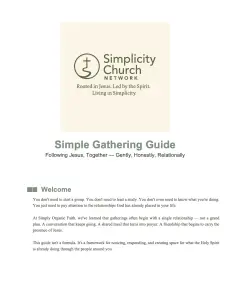
A flexible, Spirit-led framework for hosting Jesus-centered gatherings in any space.
✅ Biblical foundations
✅ Rhythms of prayer, Scripture, listening
✅ Helps for families, mixed groups, or beginners