Finding Family Across Cultures: Stories From the Edges of Mission
Key Takeaways
Mission is relational, not transactional.
True cross-cultural ministry isn’t about delivering services — it’s about sharing life with people and letting the Spirit lead.Jesus is already present in every culture.
Global mission isn’t about bringing Christ where He isn’t — it’s about recognizing and honoring where He’s already at work.Mutuality matters.
The most transformative relationships in mission are not one-sided. They involve learning from others, receiving their hospitality, and walking together as equals in Christ.Simplicity 3.0 values presence over programs.
Whether it’s under mango trees, in city alleyways, or over late-night chai, the Simplicity model embraces a slow, Spirit-led posture of listening, honoring, and responding.Spiritual family can form anywhere.
Across language barriers, social classes, and national borders, authentic, Spirit-formed relationships can emerge that reflect the Kingdom of God.You don’t need a stage to make an impact.
Many of the most powerful moments in ministry come not through preaching, but through shared meals, mutual prayer, and quiet faithfulness.The field is wherever your feet are.
Mission doesn’t begin overseas. It begins with availability — across the street or across the world — as we say “yes” to being present where Jesus leads.
I didn’t set out to find family.
I set out to serve — to respond to a calling, to preach the gospel, to teach the Word.
But what I received along the way wasn’t just ministry opportunity.
It was something deeper, more surprising… more human.
I found family in the most unexpected places.
Not because we looked alike.
Not because we agreed on everything.
But because the Spirit of God knit hearts together — across borders, language, class, and culture.
This is what I’ve come to believe:
In Spirit-led, relational mission, Jesus doesn’t just send us to work — He introduces us to His family.
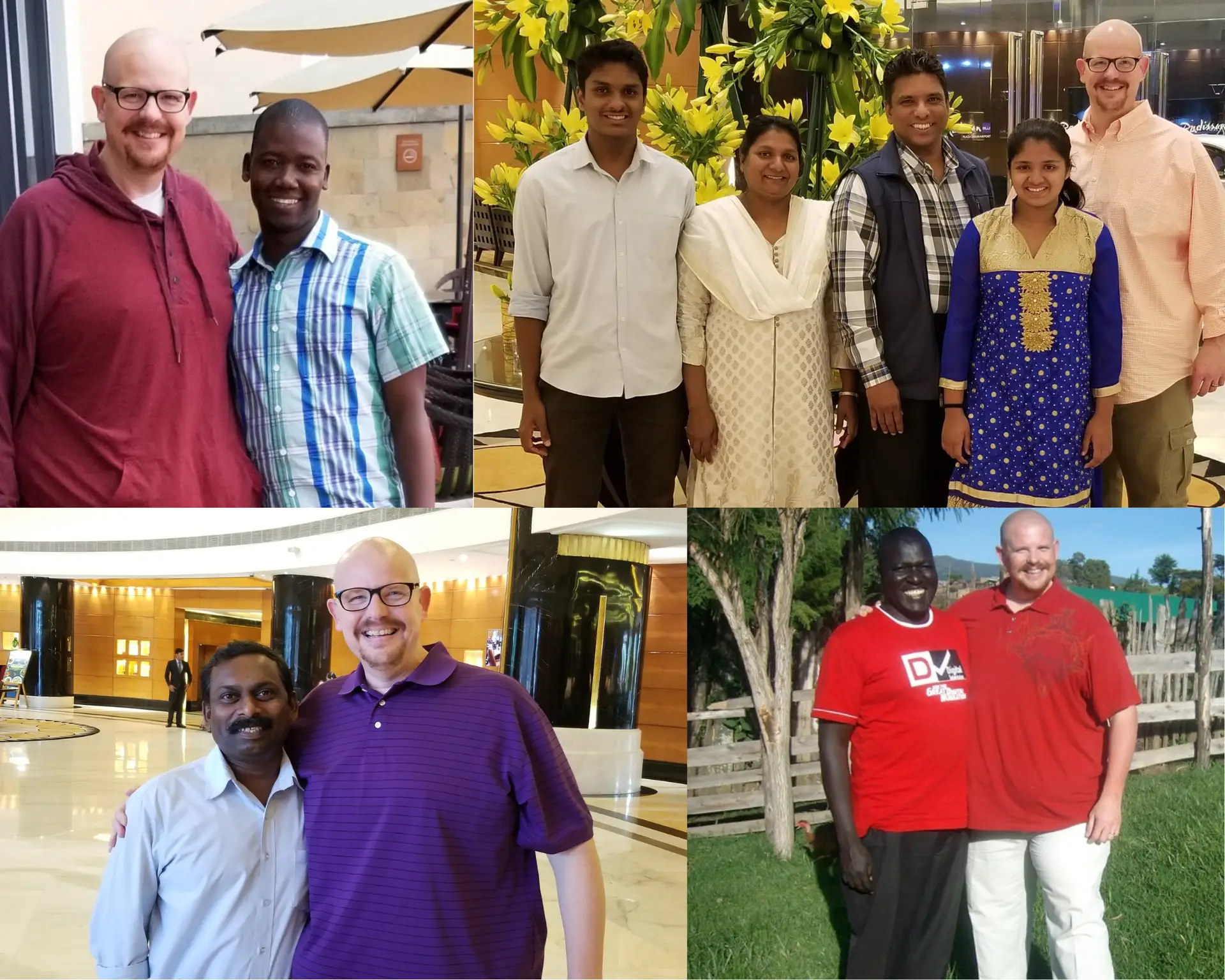
Here are just a few of their names and stories.
🇮🇳 Jacob and the Fire That Still Burns
I met Pastor Jacob in the city of Trichy, India. He didn’t introduce himself as a church planter.
He simply welcomed me with prayer and tea.
Only later did I find out that he had once been imprisoned for making bombs. A former revolutionary. A man the world tried to write off. But Jesus had stepped in — arrested his heart and rerouted his fire. By the time we met, he had planted over 400 churches and multiple Bible colleges, all under the radar, often at great cost.
What struck me most wasn’t his numbers — it was his gentleness. His willingness to listen. To laugh. To wash my feet, not literally, but in how he honored me as a guest — a younger brother.
He never asked me to “lead” anything.
Instead, he showed me how to follow the Spirit into unknown places.
🇺🇬 Godfrey: From Drunk to Disciple-Maker
In a tiny Ugandan village called Kapchesoy, I was preaching outside to a crowd of believers. Most had walked for hours to gather under the sun.
I had barely finished my sermon when the celebration broke out. People began shouting, dancing, worshiping — and I had no idea what had happened.
A local pastor leaned in and said, “You see the man at the front? That’s Godfrey. He’s the town drunk. He’s known for robbing and beating believers. But just now — he gave his life to Jesus.”
I later found out he hadn’t even been at the gathering at first. He was two miles away, cooking alcohol, when he heard what he described as my voice — calling him by name.
He ran to the service.
He encountered Jesus.
He never looked back.
A year later, Godfrey graduated from our Bible college. Today, he’s a teacher, a church leader, and has led over 30 people in his village to Christ.
I came to Uganda thinking I would disciple others.
But Godfrey discipled me — teaching me that the gospel doesn’t ride on our timing, our control, or our comfort zones.
🇰🇪 The Widow’s Bread and the Gospel of Enough
In western Kenya, I stayed with a family who didn’t have much to give.
But they gave anyway.
They served meals with portions so small I quietly worried if the children had enough to eat. When I asked the pastor about it, he said, “We share. Always. It’s how we know God will multiply.”
And He did.
The next day, I watched that same family host an impromptu prayer gathering, with worship that spilled into the streets. Teenagers, widows, workers in dust-covered clothes came forward for prayer — and the Spirit fell on that house like rain on dry land.
I didn’t preach. I barely spoke.
I just wept.
Because in that moment, I realized:
Generosity isn’t about resources.
It’s about relationship.
And where there’s faith, there’s always enough.
🕊 What the Spirit Has Taught Me About Family
Over the years, I’ve been in cathedrals and mud huts.
I’ve worshiped in English, Swahili, Tamil, and silence.
I’ve been the teacher. I’ve been the student.
I’ve been the guest. I’ve been the brother.
Through it all, the Spirit has been whispering the same thing:
“Mission isn’t what you do for people.
It’s the life you share with them.”
And honestly? That’s the heart of Simplicity 3.0.
We don’t go with an agenda.
We don’t export our culture.
We don’t build systems.
We show up.
We listen.
We honor.
We break bread.
We let the Spirit do the deep work.
Because the goal isn’t to plant a church.
It’s to recognize the Church that’s already forming — sometimes around a firepit, sometimes in a field, sometimes in the heart of someone we never expected.
✨ Mission Isn’t a Trip. It’s a Posture.
If I could say one thing to every missions-minded believer, it would be this:
You don’t have to be impressive.
You just have to be present.
Across the street or across the ocean —
You’re one conversation, one meal, one step of obedience away
from discovering the family Jesus is introducing you to.
So go slow.
Go with humility.
Go with open hands.
You may find yourself in a desolate place…
but don’t be surprised if you also find home.
Frequently Asked Questions
Q: What do you mean by “finding family” in mission work?
A: “Family” in this context means deep, Spirit-formed relationships that transcend culture, nationality, and status. These aren’t professional partnerships or ministry transactions — they’re mutual friendships built through presence, prayer, and shared life in Christ.
Q: How is this different from traditional missions?
A: Traditional missions often focus on programs, leadership structures, or church replication. In Simplicity 3.0, we focus on posture over programs. We show up relationally, listen well, and trust the Holy Spirit to guide what church and mission look like in each cultural context.
Q: Isn’t it our job to bring the gospel?
A: Yes — but the gospel isn’t something we own. We’re not “bringing Jesus” to unreached places as much as we are recognizing where He’s already at work. Our role is to join Him, honor the culture, and walk alongside people the Spirit is already drawing.
Q: What if I don’t speak the language or know the culture?
A: That’s okay. This kind of mission begins with humility and presence — not expertise. You don’t have to have all the answers. You just need to listen, pray, and let God build the bridge through real relationships.
Q: How do you avoid imposing your culture or theology on others?
A: We focus on mutual honor and Spirit-led discernment. That means asking more questions than giving answers, and allowing local believers to shape how the gospel takes root in their own context — without importing Western methods or expectations.
Q: What does “Simplicity 3.0” mean in a cross-cultural context?
A: It means that church and mission can happen anywhere — a dinner table, a dirt floor, a WhatsApp chat, or a walking trail. It’s a relational framework that doesn’t rely on buildings, budgets, or formal structures. Instead, it centers on Jesus, is led by the Spirit, and is open to all.
Q: Do I need formal training to be part of this kind of mission?
A: No. What’s most needed isn’t training — it’s availability. If you can listen, love, and let go of control, you’re already ready to serve. Many of the most impactful cross-cultural friendships begin with someone simply being present.
Q: Can I participate if I’ve been hurt by the church or burned out on ministry?
A: Absolutely. Many people in the Simplicity Church Network have walked through spiritual wounds or disillusionment. This way of mission is healing, not hype. It doesn’t pressure you to perform — it invites you to rest, reconnect, and rediscover Jesus among His global family.
Q: What’s my next step if I want to be part of this?
A: Start with prayer. Then, reach out. Whether you’re called across the street or across the sea, we’d love to walk with you as you discern what cross-cultural mission could look like — in simplicity, humility, and love.
Want to learn more about the posture of cross-cultural mission in the Simplicity 3.0 way?
Let’s talk. There’s a movement forming — without baggage, without hype, but with family at its heart.