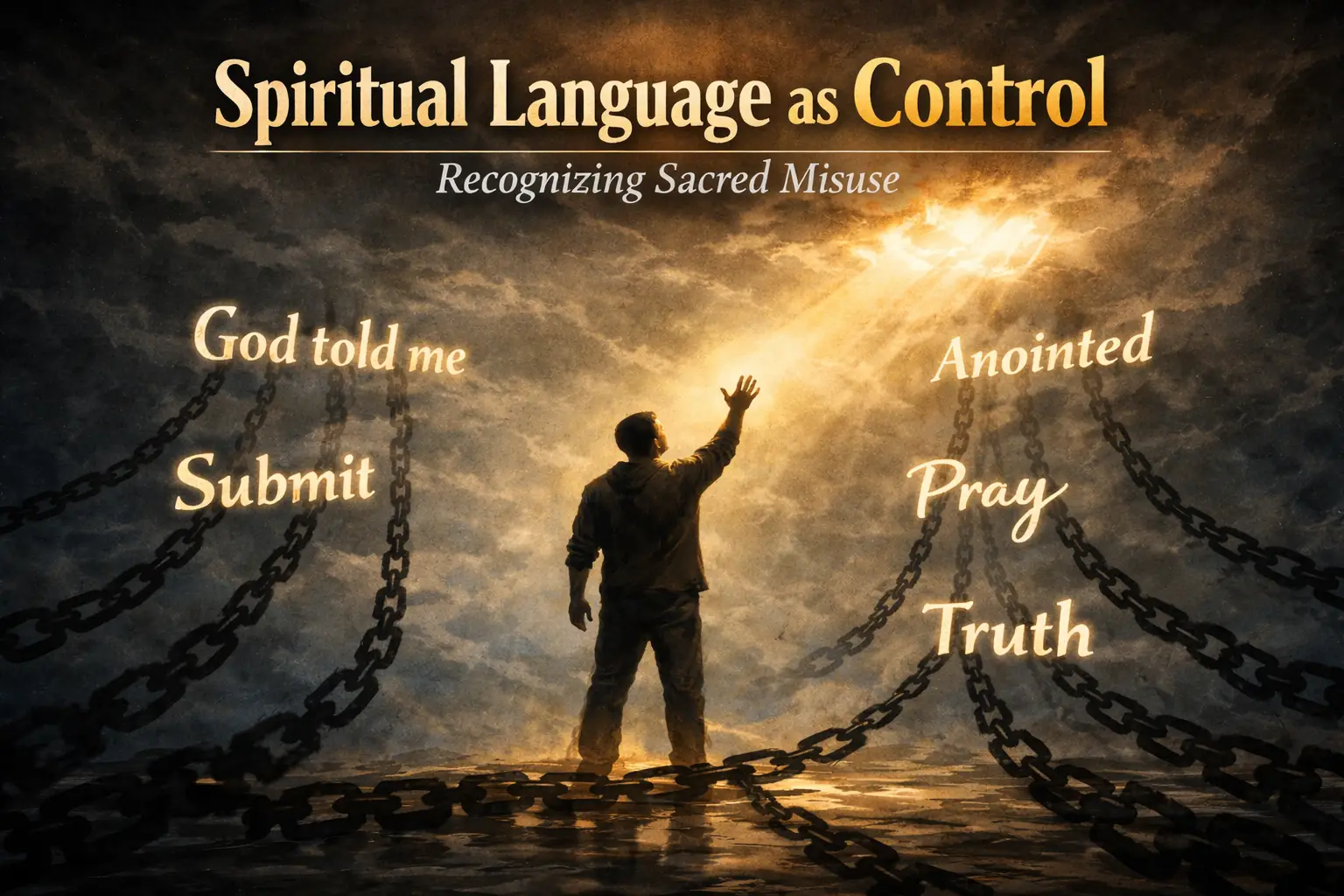
Spiritual Language as Control
Recognizing Sacred Words Used for Secular Purposes
Part 3 of the Field Notes on Discernment Series
📖 Reading Time: 35-40 minutes
📖 Quick Navigation
- → Introduction
- → The Biblical Foundation: Jesus and Spiritual Language
- → Pattern 1: “God Told Me” as Conversation Ender
- → Pattern 2: Scripture as Weapon
- → Pattern 3: Prayer as Positioning
- → Pattern 4: Vague Spiritual Warnings
- → Pattern 5: Spiritual Urgency as Pressure
- → Forgiveness & Boundaries Integration
- → Discernment Framework
- → The Healing Path
- → Conclusion
Understanding the Power and Misuse of Spiritual Language
Language is powerful.
But spiritual language—words about God, faith, Scripture, prayer, and holiness—carries unique weight. These words should point us to Jesus, draw us closer to the Father, and build up the body of Christ.
Yet the same words that express genuine faith can be used to manipulate, control, and harm.
This isn’t new. The serpent’s first words to humanity were a theological question: “Did God really say…?” (Genesis 3:1). Religious leaders used Scripture to oppose Jesus. Paul warned about those who “use godliness as a means to financial gain” (1 Timothy 6:5).
Spiritual language can serve the Spirit or serve manipulation.
This article examines how sacred words are sometimes used for secular purposes—specifically, for control, positioning, and manipulation. We’ll learn to distinguish genuine spiritual communication from spiritual language weaponized against people.
But as always, we anchor in Jesus first—because the way Jesus used spiritual language looks radically different from the manipulation we’re about to examine. And we remember that recognizing misuse of spiritual language doesn’t make us cynical. It makes us free to hear God’s voice clearly again.
Key Takeaways
💡 Takeaway 1: Jesus Never Used “God Told Me” to Shut Down Dialogue
Even though Jesus actually heard from the Father perfectly (John 5:19), He engaged questions, welcomed doubt, and invited people to test His claims. He said “Let anyone who has ears to hear listen” (Mark 4:9)—invitation, not demand. When someone uses “God told me” to end conversation rather than invite discernment, they’re not operating like Jesus. You have permission to say: “If God is speaking, He can speak to me directly too. Let’s both seek Him.”
💡 Takeaway 2: Even Satan Misused Scripture—Context Always Matters
When Satan tempted Jesus by quoting Psalm 91 out of context (Matthew 4:6), Jesus didn’t dismiss Scripture—He used it rightly: “It is also written…” (Matthew 4:7). The Pharisees studied Scripture diligently yet missed Jesus entirely (John 5:39-40). When someone uses isolated verses to control, shame, or manipulate you, they’re doing what Satan and the Pharisees did. You can reclaim Scripture by reading full passages, understanding context, and asking: “Does this lead me to Jesus and freedom, or to control and fear?”
💡 Takeaway 3: Jesus Prayed Privately Most of the Time
Mark 1:35 shows Jesus praying alone in the early morning. When He did pray publicly (John 11:41-42), it was to point to the Father, not to position Himself. He specifically warned against prayer as performance (Matthew 6:5). When people announce “I’m praying for you” as a way to establish superiority, claim spiritual authority over you, or manipulate your decisions—they’re doing exactly what Jesus warned against. Prayer is meant to connect you to God, not to give others control over you.
💡 Takeaway 4: God’s Conviction Is Specific, the Enemy’s Accusation Is Vague
Jesus was always specific when addressing sin or correcting behavior: “Go, call your husband” (John 4:16), “Martha, you are worried and upset about many things” (Luke 10:41). He named the issue clearly so it could be addressed. When someone says “I sense something dark in your spirit” or “There are things you don’t know” without specifics, they’re using vagueness as a manipulation tool. The Holy Spirit convicts with clarity that leads to repentance. Vague spiritual warnings create anxiety without path to resolution.
💡 Takeaway 5: Forgiveness + Boundaries = Christlike Response to Spiritual Abuse
Jesus forgave those who misused spiritual language against Him (Luke 23:34) AND He set clear boundaries against participating in their manipulation (Matthew 23). You can do both. Forgiveness releases them from the debt and frees you from bitterness. Boundaries protect you from future manipulation and model healthy spiritual communication. These aren’t opposites—they work together. You honor Jesus by forgiving fully while refusing to enable spiritual abuse.
The Biblical Foundation: Jesus and Spiritual Language
How Jesus Used Sacred Words
Jesus spoke more spiritual language than anyone in Scripture:
- Quoted the Old Testament constantly
- Spoke about the Father continuously
- Taught about kingdom, righteousness, holiness
- Used religious terminology freely
But notice HOW He used it:
1. To Liberate, Not Control
“The Spirit of the Lord is on me, because he has anointed me to proclaim good news to the poor. He has sent me to proclaim freedom for the prisoners and recovery of sight for the blind, to set the oppressed free” (Luke 4:18).
Jesus’ spiritual language opened doors, broke chains, gave sight, set captives free.
When spiritual language makes you feel trapped, controlled, obligated, or manipulated—it’s not being used like Jesus used it.
2. To Reveal Truth, Not Obscure It
“You will know the truth, and the truth will set you free” (John 8:32).
Jesus used spiritual language to clarify, not confuse. To reveal, not obscure. To illuminate, not manipulate.
When spiritual language makes you confused, uncertain, or doubting your own discernment—it’s being used opposite of how Jesus used it.
3. To Serve People, Not Control Them
“The Sabbath was made for man, not man for the Sabbath” (Mark 2:27).
Jesus used religious concepts to serve human flourishing, not to bind people to systems.
When spiritual language is used to make you serve the system rather than the system serving you—it’s being used opposite of Jesus’ intent.
4. To Point to the Father, Not to Himself
“Very truly I tell you, the Son can do nothing by himself; he can do only what he sees his Father doing” (John 5:19).
Even Jesus—who WAS God—used spiritual language to point beyond Himself to the Father.
When someone uses spiritual language to point to themselves, their authority, their position, their anointing—they’re not following Jesus’ pattern.
How Jesus DIDN’T Use Spiritual Language
What Jesus never did:
- ❌ Never used “God told me” to shut down discussion — Jesus invited questions, welcomed dialogue, engaged doubters
- ❌ Never used Scripture to manipulate people — When Satan tried this (Matthew 4:6), Jesus recognized and rejected it
- ❌ Never used spiritual positioning to establish hierarchy — He washed feet instead of demanding foot-washing
- ❌ Never weaponized holiness language against strugglers — He ate with sinners and defended the accused
- ❌ Never used vague spiritual warnings to control behavior — His teaching was direct, clear, specific
This is the Jesus you’re learning to trust. This is the pattern you’re learning to follow.
When people use spiritual language in ways Jesus never did, they’re not representing Him—they’re misusing His name.
Jesus Confronting Misused Spiritual Language
Jesus’ harshest words were reserved for religious people misusing spiritual language:
Matthew 23:13-15: “Woe to you, teachers of the law and Pharisees, you hypocrites! You shut the door of the kingdom of heaven in people’s faces. You yourselves do not enter, nor will you let those enter who are trying to.”
The Pharisees used spiritual language to:
- Control people’s access to God
- Establish their own authority
- Create barriers to the kingdom
- Serve their position, not God’s people
Jesus called this exactly what it was: hypocrisy.
When spiritual language creates barriers instead of access, control instead of freedom, obligation instead of invitation—it’s being used like the Pharisees used it, not like Jesus used it.
💡 The Healing Truth
Before we examine specific patterns, anchor yourself here:
- When people use spiritual language to control you, they’re not speaking for Jesus. They’re speaking like the Pharisees.
- When someone says “God told me about you” to manipulate you, they’re using Jesus’ name in vain—and He doesn’t endorse it.
- When spiritual terminology makes you feel trapped rather than free, confused rather than clear, controlled rather than loved—that’s not the Spirit’s work.
Learning to recognize misused spiritual language doesn’t make you cynical about faith. It makes you free to hear God’s actual voice clearly again.
You can forgive those who misused spiritual language against you. And you can protect yourself from future misuse.
Both honor Jesus. Both lead to freedom.
Pattern 1: “God Told Me” as Conversation Ender
The Pattern: Someone uses “God told me…” or “The Lord showed me…” to shut down dialogue, establish authority, or control outcomes.
Scenario A: The Parent
Rachel, 28, was considering a job opportunity in another state. Her mother, who wanted her to stay close, called:
“I’ve been praying about your decision, and God clearly told me you’re not supposed to take that job. I know you’re excited, but when God speaks, we need to listen. I would hate for you to miss His will by following your own desires.”
What this accomplishes:
- Positions mother as God’s spokesperson
- Makes Rachel’s discernment invalid (“your own desires” vs. “God’s will”)
- Creates guilt if Rachel proceeds (“you’d be disobeying God”)
- Ends conversation—how do you argue with “God told me”?
The manipulation: Using divine authority to enforce personal preference.
Scenario B: The Pastor
Mark felt called to plant a church but his pastor wanted him to stay on staff. In their conversation:
“I sought the Lord about this extensively, and He made it very clear—your season here isn’t finished. I believe you’re hearing your own ambition, not God’s voice. We need to trust spiritual authority. The enemy loves to use independence to shipwreck ministries.”
What this accomplishes:
- Pastor’s discernment = God’s voice
- Mark’s discernment = ambition/enemy
- Frames leaving as rebellion against authority
- Creates spiritual fear about consequences
The manipulation: Using spiritual positioning to prevent someone’s independence.
Scenario C: The Spouse
In a marriage where one spouse wanted to control financial decisions:
“I’ve been praying about our finances, and God showed me we need to cut back on your spending. I’m the spiritual head of this home, and God holds me accountable for our resources. I know you don’t see it yet, but you need to trust my leadership.”
What this accomplishes:
- Unilateral financial control masked as spiritual guidance
- “Spiritual headship” used to bypass discussion
- Other spouse positioned as spiritually immature
- No room for joint decision-making
The manipulation: Using spiritual hierarchy to control practical decisions.
Scenario D: The Ministry Leader
During a church board meeting about addressing misconduct:
“I’ve spent hours in prayer about this situation, and God gave me clear peace that we should handle this quietly. Making it public would harm the kingdom. I believe some of you are operating in fear rather than faith.”
What this accomplishes:
- Leader’s preference framed as divine instruction
- Those who disagree positioned as fearful, not faithful
- Accountability avoided through spiritual-sounding language
- Protects reputation at expense of justice
The manipulation: Using prayer claims to avoid accountability.
💚 A Word About Forgiveness
If someone has used “God told me” to control, manipulate, or shut down your discernment, you’ve been wounded by spiritual abuse.
You can forgive them for misusing God’s name to manipulate you.
Forgiveness doesn’t mean:
- Believing their “God told me” claims were legitimate
- Submitting to their control in the future
- Questioning your own ability to hear from God
Forgiveness means:
- Releasing them from the debt
- Not carrying bitterness about their manipulation
- Entrusting them to God’s judgment and correction
And you can set the boundary: “I don’t accept ‘God told me’ as conversation-ending authority. If God is speaking, He can speak to me directly. Let’s discuss this as equals who are both seeking God’s will.”
This boundary protects you from spiritual manipulation while honoring God’s actual communication patterns.
What Jesus Shows Us
Jesus never used “God told me” to shut down conversation.
Even though He actually DID hear from the Father constantly (John 5:19), He engaged questions, welcomed dialogue, and invited people to test His claims.
When teaching with divine authority, He said things like:
- “Let anyone who has ears to hear listen” (Mark 4:9) — invitation, not demand
- “Why is my language not clear to you?” (John 8:43) — engaging confusion, not dismissing it
- “If I am not doing the works of my Father, then do not believe me” (John 10:37) — offering evidence, not requiring blind trust
Jesus, who actually heard from God perfectly, invited scrutiny.
People who haven’t heard from God as clearly as Jesus did shouldn’t use “God told me” to avoid scrutiny.
When someone uses divine authority claims to shut down your discernment, they’re not operating like Jesus—they’re operating like those who opposed Him.
🎯 The Discernment Test
Genuine spiritual guidance:
- ✓ Invites your discernment too
- ✓ Offers evidence/fruit
- ✓ Welcomes questions
- ✓ Holds claims humbly (“I believe God is showing me…”)
- ✓ Points to Scripture
- ✓ Allows for disagreement
Manipulative use of “God told me”:
- ✗ Shuts down your discernment
- ✗ Demands acceptance without evidence
- ✗ Punishes questions
- ✗ Holds claims arrogantly (“God TOLD me…”)
- ✗ Selective Scripture use
- ✗ Requires agreement as proof of spirituality
If “God told me” is being used to control you, it’s not from God.
God’s actual voice leads to freedom, not control (2 Corinthians 3:17).
Pattern 2: Scripture as Weapon
The Pattern: Using Bible verses out of context to manipulate behavior, enforce compliance, or shut down legitimate concerns.
Scenario A: “Honor Your Parents”
An adult daughter, Maria, set boundaries with her emotionally abusive mother. Her mother responded:
“God commands children to honor their parents—it’s the first commandment with a promise. You’re disobeying Scripture by refusing to talk to me. The Bible says those who curse their parents will be cursed. I’m trying to protect you from bringing judgment on yourself.”
What this accomplishes:
- Uses Scripture to invalidate legitimate boundary
- Creates spiritual fear about consequences
- Positions daughter’s self-protection as sin
- Ignores context (honoring doesn’t mean unlimited access)
The manipulation: Weaponizing Scripture to maintain abusive access.
What’s missing: Ephesians 6:4 warns parents not to exasperate their children. “Honor” doesn’t mean submission to abuse.
Scenario B: “Submit to Authority”
A church member questioned financial decisions and was told:
“Romans 13 is clear—God established all authority, and rebelling against authority is rebelling against God. Your questions reveal a spirit of rebellion. If you can’t submit to leadership, you need to examine your heart.”
What this accomplishes:
- Any questioning framed as rebellion
- Spiritual fear attached to legitimate concerns
- Accountability avoided through Scripture misuse
- Leader positioned as unquestionable
The manipulation: Using Scripture to avoid accountability.
What’s missing: Acts 5:29 — “We must obey God rather than human beings.” Authority is never absolute.
Scenario C: “Submission in Marriage”
A husband used Ephesians 5:22 to demand compliance:
“Wives, submit to your husbands as to the Lord. This is God’s design for marriage. When you disagree with my decisions, you’re not just disrespecting me—you’re disobeying Scripture. I’m trying to lead our family biblically, but you keep resisting.”
What this accomplishes:
- One verse emphasized, context ignored
- Wife’s input invalidated as “resistance”
- Control masked as biblical leadership
- No room for partnership or mutual submission
The manipulation: Cherry-picking Scripture to enforce dominance.
What’s missing: Ephesians 5:21 — “Submit to one another out of reverence for Christ.” Submission is mutual.
Scenario D: “Don’t Touch God’s Anointed”
When a church member tried to report misconduct:
“The Bible warns: ‘Do not touch my anointed ones; do my prophets no harm.’ You’re bringing accusation against God’s servant. Even if you think you see something wrong, God will judge His leaders—that’s not your place. Be very careful about speaking against anointing.”
What this accomplishes:
- Scripture used to protect misconduct
- Legitimate concerns framed as spiritual danger
- Accountability avoided through fear
- Protects leader at expense of vulnerable
The manipulation: Weaponizing Scripture to prevent justice.
What’s missing: 1 Timothy 5:19-20 — Leaders who sin are to be rebuked publicly. No one is above accountability.
💚 A Word About Forgiveness
If someone has weaponized Scripture against you—using God’s Word to control, shame, or manipulate you—the wound cuts deep.
Scripture is meant to liberate. When it’s used to imprison, that’s spiritual abuse.
You can forgive them for misusing God’s Word against you.
And you can reclaim Scripture for yourself:
- Their misuse doesn’t invalidate the Bible’s truth
- Context matters—read passages fully
- Jesus used Scripture rightly; they used it wrongly
- You can trust God’s Word even when you can’t trust their interpretation
The boundary you can set: “I don’t accept proof-texting. Let’s look at full context. And I don’t accept Scripture being used to prevent accountability, enable abuse, or shut down legitimate concerns.”
This boundary protects you from manipulation while honoring Scripture’s actual intent.
What Jesus Shows Us
Even Satan misused Scripture (Matthew 4:6), quoting Psalm 91 to tempt Jesus.
Jesus’ response: Didn’t dismiss Scripture, but used it rightly: “It is also written…” (Matthew 4:7)
Jesus demonstrated:
- Scripture has context
- Verses must be understood in full teaching
- You can’t use one verse to contradict another
- The Spirit behind Scripture matters (life, not death; freedom, not bondage)
When confronting Pharisees’ Scripture misuse:
“You study the Scriptures diligently because you think that in them you have eternal life. These are the very Scriptures that testify about me, yet you refuse to come to me to have life” (John 5:39-40).
The Pharisees used Scripture for control. Jesus used it to point to Himself—to life, freedom, healing.
When people use Scripture to control you, they’re using it like the Pharisees. When you use Scripture to find Jesus and freedom, you’re using it like Jesus intended.
🎯 The Discernment Test
Scripture used rightly:
- ✓ Points to Jesus and freedom
- ✓ Considers full context
- ✓ Applies to speaker first (“I’m convicted by this too”)
- ✓ Invites growth, not manipulation
- ✓ Consistent with Jesus’ character
- ✓ Produces fruit of the Spirit (Galatians 5:22-23)
Scripture used as weapon:
- ✗ Points to speaker’s authority
- ✗ Ignores context
- ✗ Only applied to listener (“You need to…”)
- ✗ Demands compliance
- ✗ Contradicts Jesus’ character
- ✗ Produces fear, shame, confusion
If Scripture is being used to control you rather than lead you to Jesus, it’s being misused.
And you can forgive the misuse while reclaiming Scripture’s true purpose in your life.
Pattern 3: Prayer as Positioning
The Pattern: Using prayer language to establish hierarchy, demonstrate superiority, or manipulate outcomes.
Scenario A: “I’m Praying for You” as Condescension
After a theological disagreement, one person messages:
“I’m praying for you. I pray God opens your eyes to truth and softens your hardened heart. It’s painful to watch someone you care about drift from sound doctrine.”
What this accomplishes:
- Positions sender as spiritually superior
- Receiver framed as blind, hard-hearted, drifting
- “Prayer” becomes public judgment
- Maintains appearance of care while condemning
The manipulation: Using prayer language to establish hierarchy.
Scenario B: “Praying About Your Situation” as Surveillance
After someone sets boundaries, they receive:
“Just wanted you to know I’ve been in intense prayer about your situation. God has shown me some things I think you need to hear. When can we meet?”
What this accomplishes:
- Implies they have divine insight about your life
- Creates expectation of meeting on their terms
- “God showed me” positions them as authority
- Maintains connection despite boundary
The manipulation: Using prayer claims to override boundaries.
Scenario C: Public Prayer as Power Display
In a meeting where someone raised concerns, the leader responds:
“Let’s pray about this right now. Father, we come before you asking for wisdom. We pray against any spirit of division or rebellion. We ask that you would bring unity and submission to your ordained authority. Protect this body from those who would sow discord…”
What this accomplishes:
- Concerns reframed as “spirit of division”
- Public prayer positions concerned person as problem
- “Ordained authority” language reinforces hierarchy
- Spiritual intimidation through prayer
The manipulation: Using public prayer to shame and control.
Scenario D: “Covering You in Prayer” as Control
After someone becomes independent:
“I want you to know I’m covering you in prayer daily. I know this new direction feels exciting, but I’m asking God to protect you from deception and guide you back to His best. Please know I’m interceding for you.”
What this accomplishes:
- “Covering” implies ongoing spiritual authority
- New direction framed as potentially deceptive
- “Back to His best” implies current path is wrong
- Creates sense of spiritual oversight despite separation
The manipulation: Using prayer language to maintain control after loss of access.
💚 A Word About Forgiveness
When someone has misused prayer language—making you the target of condescending “I’m praying for you,” using prayer to shame you publicly, or claiming ongoing spiritual authority through “covering”—it’s a unique kind of wound.
Prayer is meant to connect you to God. When it’s used to control you, that’s spiritual manipulation.
You can forgive them for weaponizing prayer against you.
Forgiveness doesn’t mean:
- Believing their prayers were genuine
- Accepting their claim to spiritual authority over you
- Feeling obligated to meet when they say “God showed me”
Forgiveness means:
- Releasing them from the debt
- Trusting God hears YOUR prayers, not just theirs
- Knowing God’s actual covering is sufficient
The boundary you can set: “I appreciate your prayers, but I don’t accept them being used to position yourself above me or to manipulate my decisions. You can pray for me, but you don’t have spiritual authority over me.”
This boundary protects you while honoring prayer’s actual purpose.
What Jesus Shows Us
Jesus prayed constantly—but notice how:
- He prayed privately most of the time: “Very early in the morning, while it was still dark, Jesus got up, left the house and went off to a solitary place, where he prayed” (Mark 1:35).
- When He prayed publicly, it was to point to the Father, not Himself: “Father, I thank you that you have heard me. I knew that you always hear me, but I said this for the benefit of the people standing here, that they may believe that you sent me” (John 11:41-42).
- He warned against public prayer as display: “And when you pray, do not be like the hypocrites, for they love to pray standing in the synagogues and on the street corners to be seen by others” (Matthew 6:5).
Jesus modeled:
- Prayer as connection to Father, not performance for others
- Private prayer as primary, public as secondary
- Humility in prayer, not hierarchy
When people use prayer language to establish their superiority or your inferiority, they’re doing exactly what Jesus warned against.
🎯 The Discernment Test
Genuine prayer for others:
- ✓ Happens privately, mentioned sparingly
- ✓ Honors their autonomy
- ✓ Seeks their good, not your positioning
- ✓ Comes from humility, not superiority
- ✓ Doesn’t require them to know about it
Prayer as manipulation:
- ✗ Announced publicly or repeatedly
- ✗ Implies spiritual authority over them
- ✗ Serves your agenda, not their good
- ✗ Comes from superiority positioning
- ✗ Requires they acknowledge it
If “I’m praying for you” feels more like control than care, trust that discernment.
And forgive them while protecting yourself from future prayer manipulation.
Pattern 4: Vague Spiritual Warnings
The Pattern: Using ominous spiritual language to create fear, control behavior, or prevent questioning.
Scenario A: “I’m Concerned About Your Spirit”
After someone sets boundaries:
“I need to tell you—I’m genuinely concerned about your spirit right now. There’s something going on that I can’t quite put my finger on, but I’m sensing darkness. I’m worried you’re opening yourself to deception. Please be careful.”
What this accomplishes:
- Creates undefined spiritual anxiety
- “Can’t put my finger on” means you can’t address it
- “Sensing darkness” implies spiritual danger
- You’re left defending yourself against vague accusations
The manipulation: Using undefined spiritual concern to create insecurity.
Scenario B: “There’s More to the Story”
When someone shares their experience of leaving a toxic situation:
“I hear what you’re saying, but there’s more to the story that you don’t know. Things were said. Things were done. I can’t share details, but if you knew what I know, you’d understand why we’re concerned. Just trust that we see things you can’t see.”
What this accomplishes:
- Implies hidden knowledge that would change everything
- Creates doubt without providing information
- “Trust us” demands blind faith
- You can’t respond to unspecified claims
The manipulation: Using withheld information to maintain control.
Scenario C: “God is Judging This”
When someone questions leadership or leaves an organization:
“I need to warn you—when people come against God’s anointed, there are consequences. We’ve seen it happen before. I’m not saying this to scare you, but history shows that rebellion against authority doesn’t end well. I just want you to be aware.”
What this accomplishes:
- Spiritual fear about undefined “consequences”
- History of judgment referenced vaguely
- “Not trying to scare you” while explicitly scaring you
- Legitimate concerns reframed as dangerous rebellion
The manipulation: Using fear of divine judgment to prevent questioning.
Scenario D: “Others Have Expressed Concerns”
When someone’s behavior threatens your control:
“I feel I need to tell you—multiple people have come to me with concerns about you. I can’t share names or specifics, but there’s a pattern people are noticing. I’m bringing this in love because I care about you and your witness.”
What this accomplishes:
- Unspecified accusations impossible to address
- “Multiple people” creates sense of consensus
- Anonymous concerns prevent accountability
- Your “witness” threatened by undefined issues
The manipulation: Using vague collective concern to shame and control.
💚 A Word About Forgiveness
Vague spiritual warnings are particularly crazy-making because you can’t address what isn’t defined.
- “I sense darkness in you” — How do you defend against that?
- “There’s more to the story” — How do you respond to withheld information?
- “Others have concerns” — How do you address anonymous accusations?
This is spiritual gaslighting—making you question your own discernment through undefined spiritual threats.
You can forgive them for using vague spiritual warnings to manipulate you.
Forgiveness doesn’t mean:
- Accepting vague accusations as valid
- Spending energy defending yourself against undefined claims
- Living in anxiety about unspecified spiritual dangers
Forgiveness means:
- Releasing them from the debt
- Trusting God’s actual assessment of your spirit
- Knowing that legitimate concerns come with specifics
The boundary you can set: “If you have specific concerns, please share them specifically so I can address them. I don’t accept vague spiritual warnings that leave me defending myself against undefined accusations.”
This boundary demands honesty while protecting you from manipulation.
What Jesus Shows Us
Jesus was always specific:
- When confronting sin: “Go, call your husband” (John 4:16) — specific, addressable
- When warning of consequences: “Unless you repent, you too will all perish” (Luke 13:3) — clear, not vague
- When correcting behavior: “Martha, Martha, you are worried and upset about many things” (Luke 10:41) — named the issue
Jesus never said:
- “I sense something concerning about your spirit”
- “There’s more going on here that I can’t share”
- “Others have expressed concerns about you”
- “Be careful or you’ll face judgment”
Jesus was direct, specific, clear.
Vague spiritual warnings are the opposite of Jesus’ communication style.
When someone uses vague spiritual language to create fear or control, they’re not speaking like Jesus—they’re speaking like manipulators.
🎯 The Discernment Test
Genuine spiritual concern:
- ✓ Specific about observations
- ✓ Gives examples you can address
- ✓ Invites conversation
- ✓ Comes with humility (“I could be wrong”)
- ✓ Wants your growth, not your control
Vague spiritual warning:
- ✗ Undefined observations
- ✗ No examples to examine
- ✗ Shuts down conversation
- ✗ Comes with certainty (“I’m sensing…”)
- ✗ Wants your compliance, not your growth
If spiritual warnings are vague enough that you can’t address them, they’re not from God.
God’s conviction is specific. The enemy’s accusation is vague.
Pattern 5: Spiritual Urgency as Pressure
The Pattern: Using time pressure combined with spiritual language to force decisions without proper discernment.
Scenario A: “God is Moving Now”
A ministry opportunity is presented:
“I really believe God is opening this door for you, and I feel strongly that we need to move quickly. When God moves, we can’t hesitate. I’ve seen people miss their moment because they overthought instead of trusting. I need to know by tomorrow if you’re in.”
What this accomplishes:
- Time pressure prevents proper discernment
- “God is moving” makes delay seem like disobedience
- Fear of missing God’s will creates anxiety
- No time to pray, seek counsel, or consider fully
The manipulation: Using false spiritual urgency to bypass wisdom.
Scenario B: “The Enemy is Attacking”
During conflict in an organization:
“We’re under spiritual attack right now, and the enemy wants to divide us. We need to come together immediately and present a unified front. Anyone who steps back during this critical moment is giving the enemy a foothold. This is not the time for questions—it’s time for faith.”
What this accomplishes:
- Crisis language prevents thoughtful response
- “Spiritual attack” frames dissent as demonic
- Unity demanded at expense of addressing real issues
- Questions positioned as lack of faith
The manipulation: Using spiritual warfare language to suppress legitimate concerns.
Scenario C: “Don’t Grieve the Spirit”
When someone hesitates about a decision:
“I sense you’re overthinking this. Sometimes our hesitation grieves the Holy Spirit. When God calls, we’re meant to respond in faith, not analysis. Remember what happened to Lot’s wife—looking back cost her everything. I’m concerned your delay is actually disobedience.”
What this accomplishes:
- Wisdom reframed as overthinking
- Hesitation positioned as grieving God
- Biblical warning used to create fear
- Pressure to decide now or face consequences
The manipulation: Using spiritual fear to rush decision-making.
💚 A Word About Forgiveness
If you’ve been pressured into decisions through false spiritual urgency—told you’re “missing God” if you don’t decide immediately, accused of “grieving the Spirit” for wanting time to pray, or pressured during “spiritual attack” to comply without question—you’ve been manipulated.
God’s guidance includes wisdom and proper timing. Pressure tactics contradict His character.
You can forgive them for using false urgency to manipulate you.
Forgiveness doesn’t mean:
- Believing their urgency was from God
- Making rushed decisions in the future
- Feeling guilty for taking time to discern
Forgiveness means:
- Releasing them from the debt
- Trusting God’s timing isn’t manipulative
- Knowing wisdom requires time, not haste
The boundary you can set: “I don’t make significant decisions under pressure. If this is truly from God, time to pray and seek counsel will confirm it, not contradict it.”
This boundary honors God’s actual leading while protecting you from manipulation.
What Jesus Shows Us
Jesus never pressured people into rushed decisions:
- With the rich young ruler: Let him walk away rather than pressure him (Mark 10:17-22)
- With Nicodemus: Let him process slowly, coming at night to ask questions (John 3)
- With the disciples: Called them to “come and see,” not “decide right now” (John 1:39)
- With Thomas: Gave him time and evidence for his doubts (John 20:24-29)
Jesus modeled:
- Invitation, not pressure
- Time for processing
- Respect for discernment process
- Trust in Father’s timing
Proverbs 19:2 says: “Desire without knowledge is not good—how much more will hasty feet miss the way!”
God’s guidance includes wisdom and proper time for discernment.
When someone uses spiritual language to pressure rushed decisions, they’re not operating like Jesus—they’re operating like manipulators.
The Forgiveness-Boundaries Integration
Here’s how forgiveness and boundaries work together with spiritual language misuse:
💚 You Can Forgive Them For:
- Using “God told me” to shut down your discernment
- Weaponizing Scripture against you
- Misusing prayer language to position themselves above you
- Creating fear through vague spiritual warnings
- Pressuring you with false spiritual urgency
🛡️ And You Can Set Boundaries That:
- Don’t accept “God told me” as conversation-ending authority
- Require Scripture to be used in context, not as isolated weapons
- Don’t allow prayer language to establish hierarchy
- Demand specificity in spiritual concerns
- Refuse to make significant decisions under pressure
The boundaries protect your forgiveness because without them, you’d be wounded repeatedly and forgiveness would become impossible.
The boundaries love them by:
- Modeling healthy spiritual communication
- Not enabling destructive patterns
- Creating space for them to recognize misuse
- Protecting them from accumulating guilt through continued manipulation
Both together reflect Jesus:
- He forgave those who misused spiritual language
- He set boundaries against participating in it
- He modeled right use of sacred words
- He called out misuse directly when needed
The Discernment Framework
When encountering spiritual language, ask these questions:
About the Source
Does this spiritual language point to Jesus or to the speaker?
- Jesus: Liberates, clarifies, serves
- Speaker: Controls, confuses, self-serves
Does it create freedom or obligation?
- God’s Spirit: Leads to freedom (2 Corinthians 3:17)
- Manipulation: Creates bondage
Does it invite discernment or shut it down?
- Healthy: “Test this; seek God yourself”
- Manipulative: “Accept this without question”
About the Content
Is Scripture used in context or isolated?
- Faithful: Full passage, full teaching
- Weaponized: Proof-texting, cherry-picking
Are claims specific or vague?
- Genuine: Addressable, clear
- Manipulative: Undefined, impossible to respond to
Does it align with Jesus’ character?
- God’s voice: Consistent with His nature
- Manipulation: Contradicts His heart
About the Effect
How do I feel after hearing this spiritual language?
- Closer to God? (Likely genuine)
- Controlled by person? (Likely manipulation)
- Confused/anxious? (Red flag)
- Peaceful/clear? (Good sign)
Does it produce fruit of the Spirit?
- Galatians 5:22-23: Love, joy, peace, patience, kindness, goodness, faithfulness, gentleness, self-control
- If spiritual language produces fear, confusion, obligation, anxiety—it’s not from the Spirit
🙏 Bringing This to Jesus
Prayer for discernment:
“Jesus, You said Your sheep know Your voice (John 10:27). Help me distinguish Your voice from people using Your name for their own purposes.
When someone says ‘God told me,’ help me test whether it aligns with Your character and Your Word.
When Scripture is used against me, help me see context and truth.
When prayer language feels like control, help me recognize manipulation while honoring genuine intercession.
Teach me to use spiritual language like You did—to liberate, not control; to clarify, not confuse; to serve, not manipulate.
Help me forgive those who misused sacred words against me. Help me set boundaries that protect while still honoring You.
Free me from fear of Your voice. Let me hear You clearly again.”
Jesus gives you:
- Ability to hear His actual voice
- Freedom from spiritual manipulation
- Wisdom to test claims against His character
- Peace that comes from knowing Him directly
- Boundaries that honor Him while protecting you
The Healing Path: When Spiritual Language Wounds, Jesus Heals
If you’ve been wounded by spiritual language misuse—if someone used God’s name to control you, weaponized Scripture against you, or used prayer language to manipulate you—you’ve experienced spiritual abuse.
This is one of the deepest wounds because it damages your relationship with God Himself.
But Jesus specializes in healing this wound.
Jesus Never Uses Sacred Words to Harm You
When Jesus speaks to you:
- His words bring life, not death (John 6:63)
- His burden is light, not heavy (Matthew 11:30)
- His voice produces peace, not confusion (1 Corinthians 14:33)
- His conviction is specific and leads to freedom
- His correction comes with hope and help
The spiritual language that wounded you didn’t come from Him.
Even when people used His name, if it produced control rather than freedom, confusion rather than clarity, fear rather than peace—it wasn’t His voice.
Reclaiming Sacred Words
If spiritual language has been weaponized against you, you can reclaim it:
“God told me” can return to being:
- Personal guidance for your own life
- Something you share humbly, not as ultimate authority
- Subject to confirmation through Scripture, counsel, and peace
Scripture can return to being:
- Living and active (Hebrews 4:12)
- Lamp to your feet, light to your path (Psalm 119:105)
- Useful for teaching, not weapons for control (2 Timothy 3:16)
Prayer can return to being:
- Connection with your Father
- Private communion, not public display
- Source of peace, not positioning tool
The misuse didn’t invalidate the legitimate use.
Jesus is reclaiming these things for you.
Forgiving Spiritual Abuse
Practical steps:
1. Name the specific misuse
- “They used ‘God told me’ to shut down my discernment.”
- “They weaponized Ephesians 5:22 to demand submission without mutuality.”
- “They used prayer language to position themselves above me.”
Be specific. Spiritual abuse is still abuse.
2. Separate their misuse from God’s character
- Their manipulation ≠ God’s heart
- Their control ≠ God’s voice
- Their abuse of Scripture ≠ Scripture’s truth
They misused sacred things. That doesn’t make the sacred things wrong.
3. Release them to God
“Jesus, I release [name] from the debt. They misused Your name, Your Word, prayer, spiritual authority—they wounded me spiritually. I give this wound to You. I won’t carry bitterness. I won’t seek revenge. I forgive them.
“And I ask You to heal my ability to hear You clearly again. Restore my trust in Your voice. Redeem Scripture for me. Make prayer safe again.
“Help me use spiritual language like You did—to liberate, not control; to serve, not manipulate.”
4. Set protective boundaries
“I forgive them. And I’m setting these boundaries:
- I don’t accept ‘God told me’ as ultimate authority
- I test all spiritual claims against Scripture and Your character
- I require honest, direct communication, not spiritual manipulation
- I protect my ability to hear You by filtering out noise”
These boundaries protect your healing.
5. Let Jesus restore sacred language
“Jesus, teach me to:
- Hear Your actual voice clearly
- Use Scripture to find You, not control others
- Pray for connection, not positioning
- Speak truth that liberates, not manipulates
- Honor sacred things by using them rightly”
Jesus will restore what was stolen.
The Freedom You’re Reclaiming
When you forgive spiritual language misuse while setting boundaries:
You’re free from:
- Questioning your ability to hear God
- Fearing spiritual authority
- Doubting Scripture’s trustworthiness
- Believing prayer is a power game
- Spiritual manipulation and control
You’re free to:
- Hear God’s voice clearly again
- Read Scripture without triggering
- Pray without fear
- Use spiritual language rightly
- Test all claims against Jesus’ character
You’re free for:
- Intimacy with God restored
- Healthy spiritual community
- Using sacred words to liberate others
- Following Jesus’ pattern
- Freedom that comes from truth
Frequently Asked Questions
Q: Isn’t questioning “God told me” statements showing a lack of faith? Shouldn’t we trust that people hear from God?
A: Faith in God and discernment about people are not opposites—they work together.
Biblical precedent: 1 John 4:1 explicitly commands: “Do not believe every spirit, but test the spirits to see whether they are from God, because many false prophets have gone out into the world.” The Bereans were commended for examining Paul’s teaching against Scripture (Acts 17:11).
Jesus Himself invited testing: “If I am not doing the works of my Father, then do not believe me” (John 10:37). He offered evidence, welcomed questions, engaged doubters.
The issue isn’t whether God speaks—it’s whether this person heard Him accurately and whether they’re using that claim appropriately. When “God told me” is used to shut down your discernment, control your decisions, or establish someone’s authority over you, it’s being misused regardless of whether they heard something from God.
True faith trusts God enough to test claims made in His name.
Q: What if I’m being overly sensitive? Maybe I’m seeing manipulation where there’s just poor communication or cultural differences in how we talk about faith.
A: This is a thoughtful, humble question. Here’s how to discern the difference:
If it’s primarily poor communication or cultural style:
- When you express concerns, they listen and adjust
- They’re open to feedback about how their words land
- You see them using the same language with everyone consistently
- Their actions match their spiritual words over time
- Other mature believers in their life don’t express concerns
If it’s manipulation:
- When you express concerns, they defend, deflect, or increase the behavior
- They reject feedback and frame your concerns as your problem
- They use spiritual language selectively—especially when challenged
- Their actions contradict their spiritual words consistently
- Multiple people have expressed similar concerns (even if privately)
Ask yourself: After these interactions, do you feel closer to God or controlled by this person? Jesus’ voice leads to freedom (2 Corinthians 3:17). Manipulation leads to confusion and bondage.
Trust your discernment. If something consistently feels “off,” that’s data worth examining.
Q: How do I set boundaries around spiritual language without seeming unchristian or rejecting genuine spiritual guidance?
A: Boundaries honor both God and healthy relationships. Here’s how to set them wisely:
The formula: State your boundary + Explain the principle + Offer alternative
Example 1 – “God told me” claims:
“I appreciate you sharing what you’re sensing, but I don’t accept ‘God told me’ as final authority over my decisions. [Boundary] I believe God can speak to me directly, and I test all guidance against Scripture and wise counsel. [Principle] I’m happy to discuss this as two people both seeking God’s will. [Alternative]”
Example 2 – Scripture weaponization:
“I notice you’re quoting Ephesians 5:22. I’d like us to read the full passage together including verse 21 about mutual submission. [Boundary] I believe Scripture should be understood in context, not used to shut down conversation. [Principle] Can we look at what the whole section teaches? [Alternative]”
Example 3 – Vague warnings:
“You’ve mentioned concerns about my spirit, but I can’t address what isn’t defined. [Boundary] I believe genuine spiritual concern comes with specific examples I can examine. [Principle] If you have specific observations, please share them so we can discuss them. Otherwise, I’m going to trust God’s assessment of my heart. [Alternative]”
The key: You’re not rejecting God or spiritual communication. You’re requiring honesty, clarity, and healthy use of sacred language. That’s actually MORE Christian, not less.
Q: I’ve been wounded by spiritual language misuse. How do I know when I’m ready to engage spiritual community again?
A: Healing doesn’t require you to return to the same type of community that wounded you. Here are indicators you’re ready to cautiously re-engage:
Internal readiness signs:
- You can read Scripture without triggering (or triggers are manageable)
- You can pray without fear of “doing it wrong”
- You can hear “God told me” without automatic panic or shutdown
- You’ve forgiven those who wounded you (even if from a distance)
- You can discern between healthy and manipulative spiritual language
- You’re lonely for genuine community, not just avoiding isolation
What to look for in healthy community:
- Leaders who invite questions rather than demanding agreement
- Scripture used to liberate, not control
- Prayer that connects people to God, not establishes hierarchy
- Honest admission of “I don’t know” rather than claiming certainty
- Accountability structures for leadership, not just members
- People at different stages of faith journey all welcome
Wise approach: Start slow. Visit once before committing. Notice how you feel afterward. Talk to multiple people, not just leaders. Ask questions about how conflict is handled. Trust your discernment. If something feels off, that’s valid data—investigate rather than dismiss.
Remember: Jesus said “By their fruit you will recognize them” (Matthew 7:16). Healthy community produces fruit of the Spirit (Galatians 5:22-23). Give yourself time to observe the fruit before diving deep.
Q: What if I realize I’ve used spiritual language manipulatively? How do I make this right?
A: The fact that you’re asking this question shows humility and spiritual health. Here’s a path forward:
1. Acknowledge to yourself specifically what you did:
“I used ‘God told me’ to shut down my wife’s concerns about our finances.”
“I quoted Scripture to my adult child to control their decision rather than trusting their discernment.”
“I announced publicly that I was ‘praying for’ someone after they disagreed with me.”
2. Confess to God and receive His forgiveness:
1 John 1:9 promises: “If we confess our sins, he is faithful and just and will forgive us our sins and purify us from all unrighteousness.” You don’t have to earn your way back—His forgiveness is immediate and complete.
3. Make direct amends where possible:
Go to the person privately (not publicly unless the misuse was public). Say something like:
“I need to apologize. When I said [specific thing], I was using spiritual language to control/manipulate/shut you down rather than to genuinely seek God together. That was wrong. You have every right to hear from God yourself, and I should have respected your discernment. I’m sorry. I’m working on using spiritual language the way Jesus did—to liberate, not control. Will you forgive me?”
4. Change the pattern going forward:
- Share spiritual insights humbly: “I sense God might be…” rather than “God told me…”
- Use Scripture to invite reflection, not demand compliance
- Pray privately most of the time; publicly only to point to God, not yourself
- Be specific when you have concerns, not vague
- Respect others’ discernment process and timing
5. Get accountability:
Ask a trusted friend or counselor to help you recognize when you slip back into manipulative patterns. Growth requires community.
Remember: God delights in transforming us. Your awareness is the first step. Your humility in making amends is powerful witness. Your changed behavior will speak louder than your words.
Q: How do I help my children/loved ones recognize spiritual language manipulation without making them cynical about faith?
A: This is one of the most important questions for parents and mentors. Here’s a framework:
Teach discernment, not suspicion:
Poor approach: “Don’t trust anyone who says ‘God told me’—they’re probably manipulating you.”
Better approach: “When someone says ‘God told me,’ ask yourself: Does this lead me closer to God or more dependent on this person? Does it give me freedom to seek God myself, or does it shut down my discernment?”
Use Jesus as the standard:
“Let’s look at how Jesus used spiritual language…” Then show them the examples from this article. When they see Jesus inviting questions, using Scripture in context, praying privately, being specific—they have a template for healthy spiritual communication.
Process experiences together:
When they encounter spiritual language (at church, from friends, in media), ask:
“How did that make you feel?”
“Did that point you to Jesus or to the speaker?”
“Did you feel free or controlled?”
“What fruit did you see in that person’s life?”
Model healthy use yourself:
Your children are watching how YOU use spiritual language. Do you:
– Share spiritual insights humbly?
– Invite their discernment rather than demand agreement?
– Admit when you’re uncertain?
– Use Scripture to guide, not control?
– Respect their own relationship with God?
Affirm their discernment:
When they say “Something felt off about how that person talked about God,” don’t dismiss it. Explore it: “Tell me more. What specifically felt off?” Help them articulate their discernment, which strengthens it.
The goal: Raise people who love God, trust His Word, value authentic spiritual community, AND can recognize when sacred things are being misused. This isn’t cynicism—it’s wisdom. Proverbs 2:6 says “The Lord gives wisdom; from his mouth come knowledge and understanding.”
Conclusion
Spiritual language matters.
Sacred words carry weight—weight that can liberate or imprison, clarify or confuse, serve or control.
But here’s what matters most:
Jesus used spiritual language to set captives free, not to keep them imprisoned.
When you learn to recognize spiritual language misuse, you’re not becoming cynical about faith—you’re becoming wise about manipulation.
When you set boundaries against “God told me” claims, Scripture weaponization, prayer manipulation, vague warnings, and false urgency—you’re not rejecting God. You’re protecting your ability to hear Him clearly.
When you forgive those who misused sacred words against you while refusing to participate in that pattern—you’re walking like Jesus walked.
The manipulators will misuse His name. They’ll weaponize Scripture. They’ll use prayer for positioning. They’ll create fear through vague warnings. They’ll pressure through false urgency.
But Jesus?
- His voice produces freedom, not control.
- His words clarify, not confuse.
- His Spirit liberates, not imprisons.
- His burden is light, not heavy.
- His truth sets you free.
Learn to recognize manipulation patterns.
Forgive those who misused sacred words.
Set boundaries that protect your hearing.
But never let misuse make you doubt God’s actual voice.
People will misuse spiritual language. Jesus never does.
Discern the difference.
Forgive the misuse.
Follow Jesus’ pattern.
And walk in the freedom He secured for you.
John 8:32: “You will know the truth, and the truth will set you free.”
Truth about spiritual language misuse sets you free from:
- Manipulation disguised as guidance
- Control masked as spirituality
- Bondage presented as God’s will
And sets you free for:
- Hearing God’s actual voice
- Using spiritual language rightly
- Walking in authentic freedom
2 Corinthians 3:17: “Now the Lord is the Spirit, and where the Spirit of the Lord is, there is freedom.”
Recognize manipulation.
Forgive fully.
Protect wisely.
Hear clearly.
Walk freely.
This is what Jesus purchased for you.
This is the freedom He offers.
Claim it. Live it. Share it.
📚 Next in this series:
“The Witness Principle: Why Difficult Conversations Benefit from Observers”
Part 4 of the Field Notes on Discernment Series
🤔 For Reflection
Before the next article, consider:
- Have I experienced spiritual language being used to control me?
- How has that affected my relationship with God?
- Can I distinguish between misuse and legitimate spiritual communication?
- What boundaries would help me hear God’s actual voice more clearly?
- How can I use spiritual language to liberate, not control?
- Have I forgiven those who misused sacred words against me?
- Am I ready to reclaim Scripture, prayer, and God’s voice for myself?
“Let sacred words be sacred again.”
“Let God’s voice be His voice, not theirs.”
“Forgive the misuse.”
“Protect your hearing.”
“Trust Jesus’ voice—it sounds like freedom.”
Resources