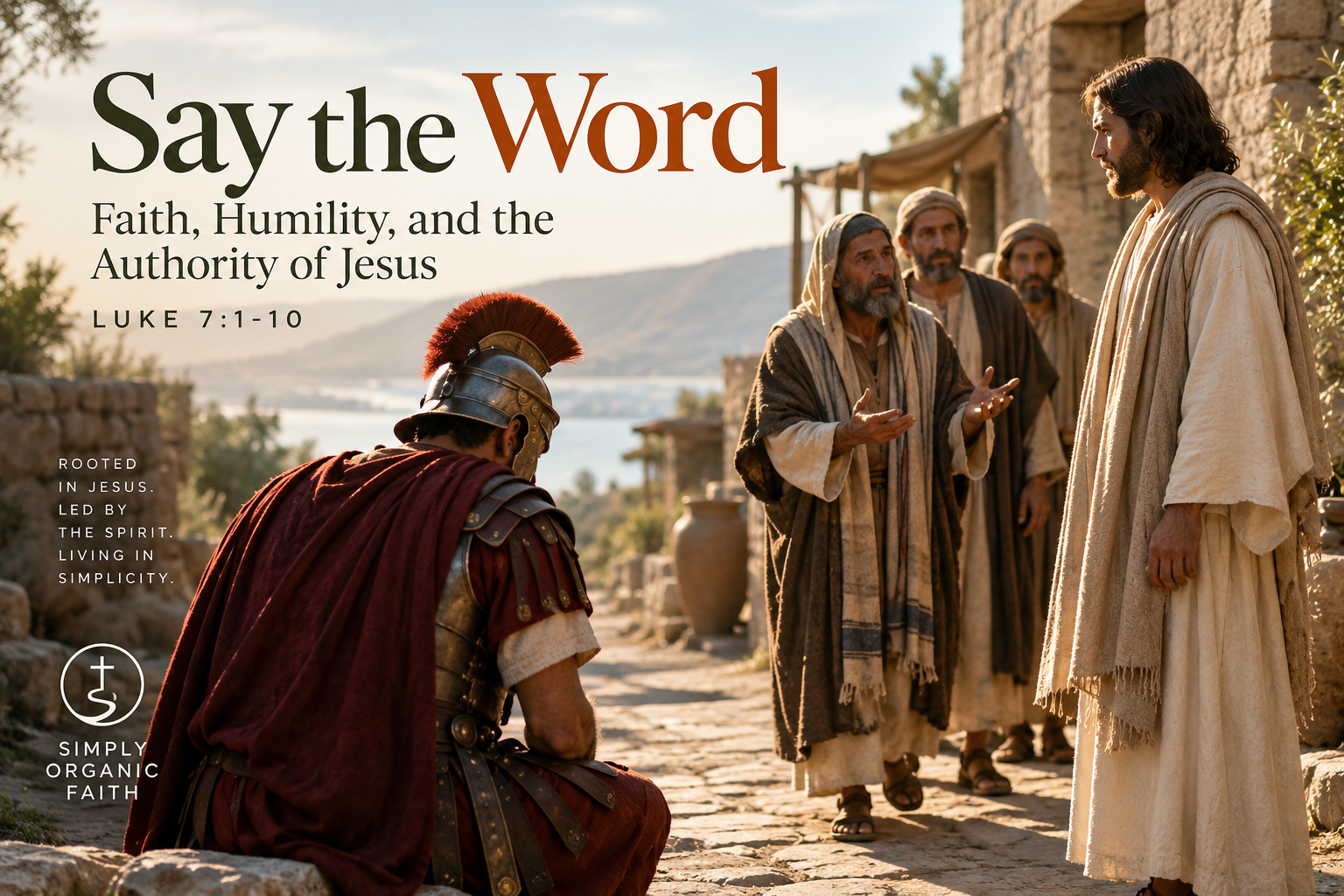
Bible Teaching • Luke 7:1–10
Say the Word: Faith, Humility, and the Authority of Jesus
What the faith of a Roman centurion teaches us about compassion,
intercession, humility, and trusting the authority of Jesus.
Sometimes people come to us because they do not know how to approach God
for themselves.
They may not use theological language. They may simply say,
“Would you pray for me?”
Their marriage is struggling. Someone they love is sick. Their child is
hurting. They are frightened about something they cannot fix.
Beneath the request is often something deeper:
I need help bigger than me.
Luke 7:1–10 introduces us to a man who found himself in exactly that
position. He was powerful by almost every human measure. He commanded
soldiers. He carried Roman authority. He had resources and influence.
But someone he cared about was dying, and none of his authority could
change it.
So he turned toward Jesus.
“But say the word, and let my servant be healed.”
Luke 7:7
That single sentence opens a window into the kind of faith that caused
Jesus Himself to marvel.
Key Takeaways from Luke 7:1–10
- Compassion notices people others may overlook.
- Intercession carries the needs of others into the presence of Jesus.
- Grace is not earned by being worthy enough.
- Humility and bold faith can exist together.
- Jesus possesses authority that reaches beyond our limitations.
- Faith grows as we hear the word of Christ and respond to what we hear.
1. Compassion Notices the Person Others Might Overlook
Luke tells us that the centurion had a servant who was seriously ill and
near death. He also tells us something important about the relationship:
the servant was highly valued by him.
The centurion could have treated the servant as disposable. Instead, the
suffering of this man mattered to him.
That is where the passage begins—not with spectacular faith, but with
compassion.
It is possible to become so busy, so self-protective, or so accustomed to
the pain around us that we stop noticing people. We can look at another
person’s difficulty and quietly think, They should figure that out.
Jesus keeps forming something different in us.
Faith does not make us less attentive to human suffering. The closer we
walk with Jesus, the more room compassion should have in us.
The first question this passage may ask us is simple:
Have I stopped noticing the people around me?
2. Someone Had Been Talking About Jesus
Luke says that the centurion heard about Jesus.
That phrase is easy to move past, but it matters. Somehow, word had reached
this Roman officer about what Jesus was saying and doing.
Someone had been talking.
The centurion had heard enough to believe that Jesus was worth seeking.
What he had heard moved him to act.
Romans 10:17 later gives us language for this:
“So faith comes from hearing, and hearing through the word of Christ.”
Romans 10:17
We do not need to turn every conversation into a sermon. But we also do
not need to hide what Jesus is doing in us.
There are people around you who may someday need someone they trust to
pray with them. Quietly speaking about the faithfulness of Jesus lets them
know where you turn when life becomes larger than you.
If you are learning to recognize His voice more clearly, you may also find
Hearing God in the Quiet: How to Listen and Know His Voice
helpful.
3. Intercession Brings Someone Else’s Need to Jesus
The centurion did not initially approach Jesus himself. He sent Jewish
elders to ask Jesus to come.
In one sense, this is a picture of intercession: someone carrying another
person’s need toward Jesus.
We do this whenever we hold someone’s name before God.
We cannot change another person’s heart. We cannot heal every wound. We
cannot rescue someone by our own wisdom. But we can bring them before the
One who can do what we cannot.
Intercession is not trying to control God. It is refusing to stop caring.
It may mean praying for the same person for years. It may mean asking God
for an opening into a neighbor’s life. It may mean carrying the name of a
child, friend, coworker, or family member before Him again and again.
You do not have to manufacture the answer. Your invitation is to keep
bringing the person you love before Jesus.
For a deeper look at Jesus’ own pattern of prayer, see
How to Pray According to Jesus
.
4. Grace Is Not Given Because We Are Worthy Enough
The Jewish elders approached Jesus with an argument based on merit.
They told Him that the centurion was worthy. He loved their nation. He had
even helped provide their synagogue.
Their reasoning was essentially:
He has done good things, so he deserves something good from You.
But the centurion himself saw the situation differently.
“Lord, do not trouble yourself, for I am not worthy to have you come under
my roof.”
Luke 7:6
Here is the tension at the heart of grace.
The elders said, “He is worthy.”
The centurion said, “I am not worthy.”
And Jesus came anyway.
This is not a story about convincing ourselves that we deserve God’s
attention. It is a story about trusting the goodness and authority of
Jesus even when we know we cannot place Him in our debt.
We do not approach God because our record is impressive enough. We come
because Jesus has opened the way.
5. Humility Does Not Produce Timid Faith
The centurion’s humility did not keep him from asking.
In fact, his humility existed alongside extraordinary confidence.
He did not say, “I am unworthy, so there is no point in praying.”
He said, in effect:
I am unworthy, but You have authority. Say the word.
That is a very different posture.
Biblical humility is not pretending that Jesus is small. It is recognizing
that we are dependent and He is sufficient.
Sometimes our prayers sound hesitant because we have confused humility
with uncertainty about God’s power. The centurion shows us another way.
Humility says, “I cannot do this.” Faith adds, “But Jesus can.”
6. “Say the Word”: The Centurion Recognized the Authority of Jesus
The centurion understood authority because he lived inside a chain of
command.
He was under authority, and he carried authority. When he told a soldier
to go, the soldier went. When he told another to come, the soldier came.
And somehow he recognized something in Jesus that many religious people
around Jesus had not yet recognized.
Jesus did not need to enter the house.
Jesus did not need to touch the sick servant.
Distance was not a limitation.
“Say the word.”
Earlier in Luke, Jesus had already demonstrated this kind of authority.
His word confronted sickness and spiritual darkness. That same theme is
explored further in
The Authority of Jesus: When His Word Confronts Darkness and Disease
.
The centurion was not trusting a technique. He was trusting a Person.
His faith rested in who Jesus was.
7. Prayer Is Not Only Speaking; It Is Also Listening
There is another implication worth sitting with.
If Jesus has authority, then prayer is not merely the place where we tell
Him what we want. Prayer also becomes a place where we listen.
One of the simplest prayers we can pray is:
“Lord, how do You want me to pray about this?”
Instead of assuming we know the whole situation, we can become attentive
to His heart.
“What are You doing here?”
“What do You want me to notice?”
“Is there something You want me to do?”
“Is there someone You want me to encourage?”
“How would You have me pray?”
This is part of learning to be led rather than merely driven by our own
conclusions.
Within the missional and leadership setting of the
Simplicity Church Network, prayer that leads
carries the same emphasis: what happens publicly should grow from
attentiveness to Jesus in the secret place.
8. Jesus Marveled at His Faith
“I tell you, not even in Israel have I found such faith.”
Luke 7:9
The centurion did not possess years of theological training.
He simply heard about Jesus, believed what he heard, recognized His
authority, and acted on it.
That gives us a helpful way to think about growing faith.
Faith is not merely agreeing that something about Jesus is true. Faith
begins to shape what we do because we believe He is trustworthy.
That is why spiritual formation is not primarily about gathering more
information. We hear the words of Jesus and learn to respond.
If you are in a season where you want to grow slowly and honestly in that
kind of trust, see
Growing in Faith: Simple Steps Toward Spiritual Maturity
.
9. Who Are You Carrying Before Jesus?
The centurion’s faith was not focused only on himself.
Someone else was suffering, and compassion moved him to seek Jesus on that
person’s behalf.
There may be someone in your life right now whose name needs to remain in
front of you in prayer.
Not as a project.
Not someone to pressure.
Someone to love.
Someone to listen to.
Someone whose name you quietly continue bringing before God.
You might write three names somewhere you will see them regularly. Pray
for them without trying to control the outcome. Ask God for natural
openings into their lives. Pay attention to what He does.
Intercession can eventually move us outward in very practical ways. The
Network’s teaching on
prayer walking with purpose, power, and authority
explores one expression of carrying prayer into the places where we
already live and serve.
The Faith That Says, “Jesus, You Are Able”
Luke 7 does not invite us to become impressed with the centurion.
It invites us to see what the centurion saw in Jesus.
He saw authority.
He saw his own dependence.
He saw that distance was no obstacle.
And he trusted that one word from Jesus was enough.
Perhaps that is where this passage can meet us today.
You may be carrying something you cannot fix.
You may be praying for someone whose heart you cannot change.
You may feel deeply aware of your own inadequacy.
None of those realities disqualify you from coming to Jesus.
You need to know where the authority rests.
Bring the need to Him.
Listen.
Trust His character.
And take the next step of obedience He places in front of you.
Frequently Asked Questions About Luke 7:1–10
Why did Jesus marvel at the centurion’s faith?
The centurion trusted Jesus’ authority so completely that he believed
Jesus could heal his servant simply by speaking. Jesus highlighted this
trust as remarkable faith.
What does the centurion teach us about humility?
He did not approach Jesus on the basis of personal merit. He openly
acknowledged his unworthiness while still trusting Jesus’ willingness and
authority. Biblical humility does not keep us away from Jesus; it teaches
us to depend on Him.
What does Luke 7 teach about intercessory prayer?
The passage shows one person seeking Jesus because of another person’s
suffering. In the same way, we can faithfully bring the needs and names of
others before God while trusting Him with the outcome.
Does strong faith guarantee that every prayer will be answered exactly as we ask?
Luke 7 emphasizes confidence in Jesus rather than a formula for controlling
outcomes. Faith trusts His authority and character while remaining
attentive to His will.
How can I grow in the kind of faith seen in the centurion?
Begin where the centurion began: hear what is true about Jesus, take His
words seriously, bring your needs to Him, listen, and respond in
obedience. Romans 10:17 connects growing faith with hearing the word of
Christ.
Reflection Questions
- Is there someone whose suffering I have stopped noticing?
- Who currently comes to mind when I think about interceding for another
person? - Do I tend to approach God based on how worthy or unworthy I feel?
- What does the centurion seem to understand about Jesus that I need to
recover or deepen? - Where am I currently facing something beyond my ability to control?
- What might change if I asked, “Lord, how do You want me to pray about
this?” before saying anything else?
Simple Action Steps
- Write down three names.
Choose three people you want to hold consistently before God in prayer. - Pray before prescribing.
Before deciding what someone else needs, ask God how He wants you to
pray for them. - Listen for one simple act of obedience.
It may be a phone call, an encouraging message, a meal, an apology, or
simply remaining available. - Pay attention to what Jesus is doing.
Rather than forcing an outcome, notice the openings, conversations, and
changes that unfold over time.
Closing Prayer
Jesus, give me a heart that still notices people.
Keep me from becoming detached from the pain around me. Teach me to carry
people before You with compassion rather than trying to fix them with my
own strength.
I acknowledge that I cannot control outcomes, change hearts, or solve
every situation. But You are Lord, and Your authority is greater than my
limitations.
Teach me to pray with humility and confidence. Help me listen before I
speak, trust before I understand, and obey when You show me the next step.
Give me faith that rests not in my own worthiness, but in who You are.
Amen.